Project Management and Model-Based Systems Engineering (MBSE) are closely intertwined disciplines, particularly in managing complex engineering projects. Their integration brings together the strengths of structured planning, coordination, and technical rigor to deliver successful systems.
Key Ways Project Management and MBSE Interact
1. Coordinated Planning and Execution
Project management is responsible for organizing, planning, and supervising the activities required to deploy a system. At the same time, MBSE provides a technical methodology for designing, analyzing, and managing systems through models and simulations. Project managers coordinate the actions of all stakeholders and ensure the system is delivered on time and within budget, and that it meets requirements. In contrast, MBSE ensures technical integrity and traceability throughout the lifecycle.
2. Single Source of Truth
MBSE creates a comprehensive system model that acts as a single source of truth. Project management leverages this model to align tasks, schedules, and deliverables, ensuring everyone works from the same information and reducing misunderstandings between technical and managerial teams.
3. Improved Communication and Collaboration
MBSE provides a common language and visual models that bridge the gap between engineers, project managers, and other stakeholders. This enhances communication, helps clarify requirements, and supports better decision-making throughout the project lifecycle.
4. Requirements and Traceability Management
MBSE’s model-centric approach allows for rigorous requirements management and traceability. Project management relies on these features to track progress, manage changes, and ensure that all requirements are met as the project evolves.
5. Integration with Project Management Methodologies
MBSE can be integrated with methodologies like Agile and Lean Six Sigma. In Agile environments, MBSE adds structure and traceability to iterative development, while in Lean Six Sigma, MBSE models help identify process improvements and optimize system performance.
Lifecycle and Configuration Management
MBSE supports the entire system lifecycle, from concept through disposal. Project management tools that integrate MBSE (such as Innoslate) help maintain configuration control, manage changes, and ensure consistency across the project.
6. Organizational Structure and Documentation
The Project Management Plan (PMP) outlines all project activities, including technical activities. At the same time, the Systems Engineering Management Plan (SEMP) details the technical methodologies and processes (including MBSE) used on the project. These documents must remain consistent and evolve together, ensuring that technical and managerial activities are aligned.
Project Management vs. MBSE Roles
| Aspect 🔍 |
Project Management 📆 |
MBSE (Model-Based Systems Engineering) 📊 |
| Primary Focus |
Schedule, budget, stakeholder coordination |
Technical design, requirements, system modeling |
| Key Deliverables |
Project plans, schedules, progress reports |
System models, requirements traceability, analyses |
| Communication |
Stakeholder engagement, reporting |
Visual models, technical documentation |
| Tools/Methods |
Gantt charts, WBS, Agile, Lean Six Sigma |
SysML, LML, and other domain-specific modeling tools |
| Integration Point |
Aligns project tasks with technical milestones |
Provides technical data for project decisions |
| Lifecycle Involvement |
All project phases |
All system lifecycle phases |
Benefits of Integrating MBSE and Project Management
- Enhanced efficiency and reduced errors through early identification of inconsistencies
- Better alignment of technical and managerial objectives
- Improved adaptability and responsiveness to change
- Stronger traceability and configuration management
Challenges and Solutions
- Complexity: Large MBSE projects can be challenging to manage; effective project management is essential to coordinate teams and activities.
- Standardization: The absence of universal MBSE standards can impede integration. However, the Lifecycle Modeling Language includes project manager stakeholders. LML includes cost, time, and schedule into its ontology.
- Cultural Shift: Successfully integrating MBSE with traditional project management requires organizations to balance technical rigor with flexibility.
Measuring Successful Project Management and MBSE Integration Efforts
Reduction in Project Delivery Time
This metric evaluates how quickly projects are completed after integrating MBSE with project management. A significant decrease in delivery time is a strong indicator of improved efficiency and streamlined processes.
Improved Quality of Systems Engineering Outputs
This measures the accuracy, completeness, and usability of system models and documentation. Higher-quality outputs reflect a better understanding, fewer errors, and enhanced stakeholder collaboration.
Enhanced Return on Investment (ROI) and Cost Savings
ROI quantifies the financial benefits gained from MBSE and project management integration, such as reduced rework, fewer errors, and more efficient resource utilization, compared to the investment in tools and training.
These three metrics, project delivery time, quality of engineering outputs, and ROI/cost savings, are widely recognized as the most critical indicators of successful MBSE and project management integration.
Integrating Project Management and MBSE
Innoslate bridges Model-Based Systems Engineering (MBSE) and project management by providing a unified, web-based platform that covers the entire system and project lifecycle. Here’s how Innoslate specifically enables this integration:
- Unified Lifecycle Management
- Comprehensive Modeling and Planning Tools
- Requirements and Traceability
- Collaboration and Communication
- Risk and Configuration Management
- Lifecycle and Agile Support
- Reporting and Analytics
Innoslate’s Project Management Dashboard Overview
The Project Management dashboard allows project managers and other users to view important upcoming dates and deadlines, Calendar events, Kanban Board progress, hierarchical breakdowns of Kanban Boards, and interactions with the Gantt Chart Diagram. Having this dashboard directly in your MBSE software allows for seamless traceability and reduces errors.
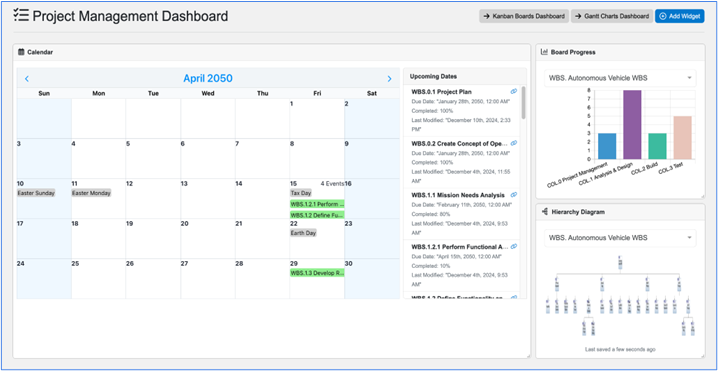
Calendar
The Calendar feature in Innoslate allows users to track events occurring at defined dates within the Gantt Chart or Timeline diagrams. Whether users add events manually or automatically, teams can find them in the Calendar via the "Task" entity class, where they can use the Calendar Chart to track upcoming event dates or change specific attributes based on their immediate needs.
.png?width=560&height=297&name=Project%20Management%20Dashboard%20(2).png)
Board Progress
The Board Progress widget provides a bar chart of your project's progression. It shows the stages of your workflow as columns on the Kanban Board, with tasks represented as cards moving from one column to the next as work progresses.
This widget gives you a quick overview of the project's progress, helping you identify bottlenecks and maintain smooth project progression.
.png?width=344&height=298&name=Board%20Progress%20(2).png)
Kanban Board
Innoslate's ability to trace entities simultaneously throughout the project enables the "Action/Task" entities to be utilized in the Kanban Board. This facilitates task management by tracking task phases, completion percentages, descriptions, assignments, and due dates.
These features help organize tasks effectively and maintain consistency with the project plan.
.png?width=490&height=338&name=Kanban%20Board%20(2).png)
Gantt Charts
The Gantt Chart in Innoslate is a critical tool for effective project planning and tracking. It provides a timeline view of tasks, dependencies, durations, and progress, enabling a comprehensive understanding of the project’s timeline and status. Entities on the Gantt Chart can be further simulated using the Action Diagram.
.png?width=561&height=311&name=Gantt%20Chart%20(4).png)
Conclusion
Project management and MBSE are complementary disciplines. Project management provides the structure and oversight needed to deliver complex systems on time and within budget, while MBSE ensures technical excellence and traceability through model-based approaches. Their integration is essential for the successful delivery of modern, complex engineering projects, enabling teams to manage complexity, foster collaboration, and achieve project goals efficiently.
More Readings:

.jpg) Amir Abrari
Amir Abrari

.svg) Elizabeth Steiner : 10/2/24, 3:22 PM
Elizabeth Steiner : 10/2/24, 3:22 PM
.svg)
.svg)
%20(1).png)
.svg)