
Skip to the main content.
Logo-Text-without-slogan-white-300x88

AI built for systems engineers

Innoslate AI supports requirements, models, and verification processes.

Three ways AI works in Innoslate

1. AI chat

Two AI chat tools support different needs:

  • AI Assistant
    Ask questions, explore ideas, and generate content for engineering tasks.
    Useful for drafting requirements, brainstorming, and general support.
  • HelpBot
    Get answers based on the Innoslate Help Center.
    Quickly find guidance on features, workflows, and best practices.

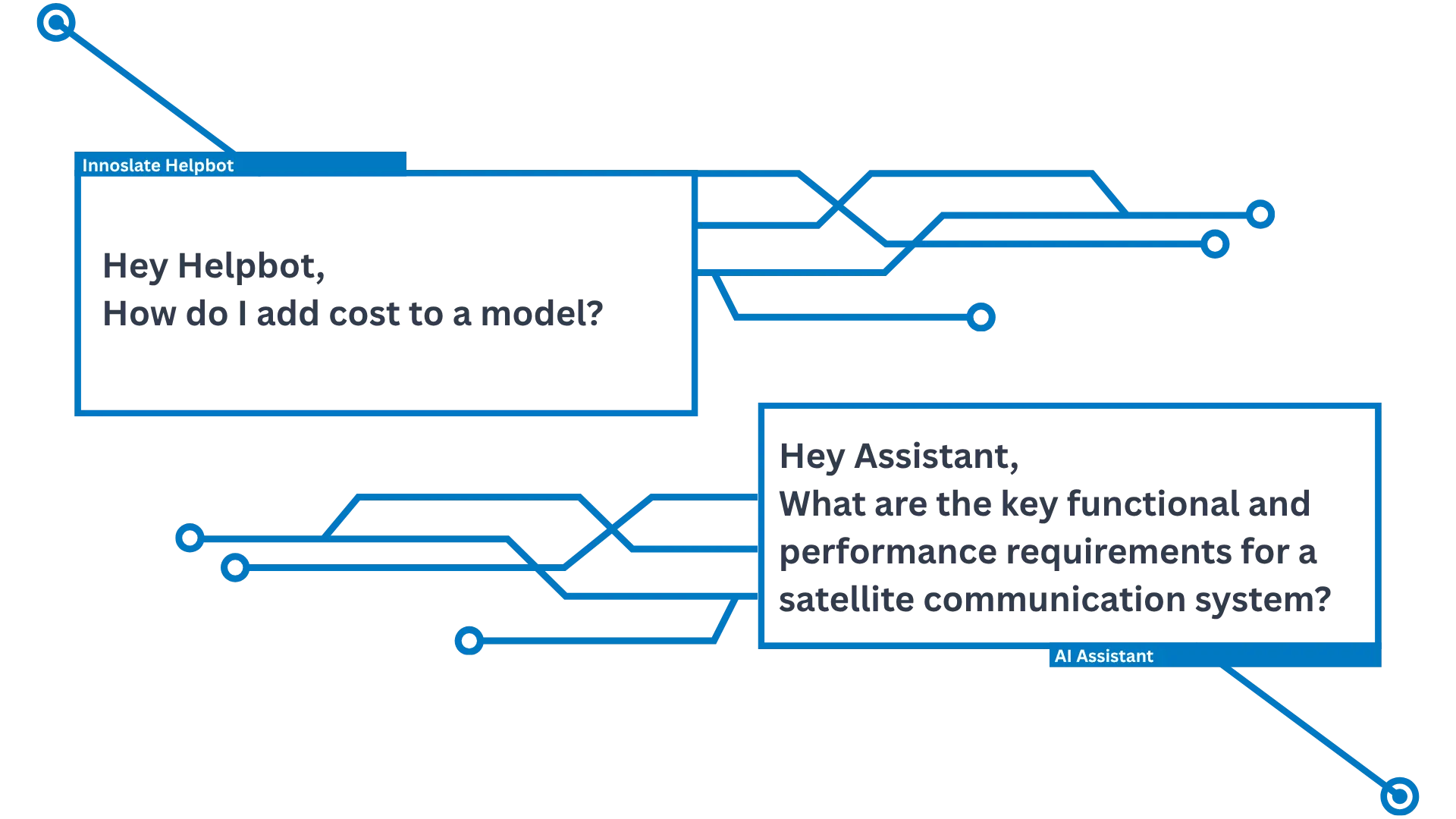
AI Assistant helps you do work.
HelpBot helps you learn the tool.

See AI Assistant in action
Helpbot and AI Assistant illustration

ai-technology

2. LLM-powered engineering tools (Optional Integration)

Extend Innoslate with your preferred LLM.

Test Case AI for Requirement Entities

powered by LLM technology
  • Accelerate test case creation while maintaining consistency with Innoslate attributes.
  • Establish automatic traceability by directly linking requirements to test cases.
  • Allow engineers to focus on refining and validating test content rather than creating it from scratch.

Innoslate 4.11 Test Case AI (1600 x 1200 px) (1)


Translate Documents Instantly

powered by LLM technology
  • Provide accurate and structured translations across 17 supported languages, including English, Spanish, French, German, and more.
  • Maintain the integrity of hierarchical document structures during translation.
  • Simplify the translation of large, complex documentation with an efficient, entity-based workflow.

Innoslate 4.11 Translate AI (1600 x 1200 px) (2)


Risk AI

powered by LLM technology
  • Provide an intuitive workflow for identifying risks related to specific project elements.
  • Allow engineers to customize and validate the generated risks to address specific unacknowledged needs identified by the AI.
  • Enhance traceability and documentation by embedding risks directly into the Risk Diagram while creating the "causes/caused by" relationship.

Innoslate 4.11 Risk AI (1600 x 1200 px)


Summarize AI

powered by LLM technology
  • Provide users with quick, actionable insights from detailed documents.
  • Customize summaries to fit different content, including varying levels of detail and different languages.
  • Automatically embed summaries in the document.

Innoslate 4.11 Summarize AI (1600 x 1200 px)


Text Prompt AI

powered by LLM technology
  • Automated context fetching of rich text editor text using predefined templates.
  • Customize the tone of the generated text to fit diverse communication needs, with options ranging from Professional to technical.
  • Preview the AI-generated text, enabling users to review and refine it before insertion.

Innoslate 4.11 AI Text Prompts(1600 x 1200 px)


Image Generation AI

powered by LLM technology
  • Generate customized AI images
  • Choose from a wide variety of styles and sizes.
  • Streamline image creation
  • Improve communication and provide additional clarity for complex projects and entities.


Innoslate 4.11 AI Image Generation (1600 x 1200 px) (1)


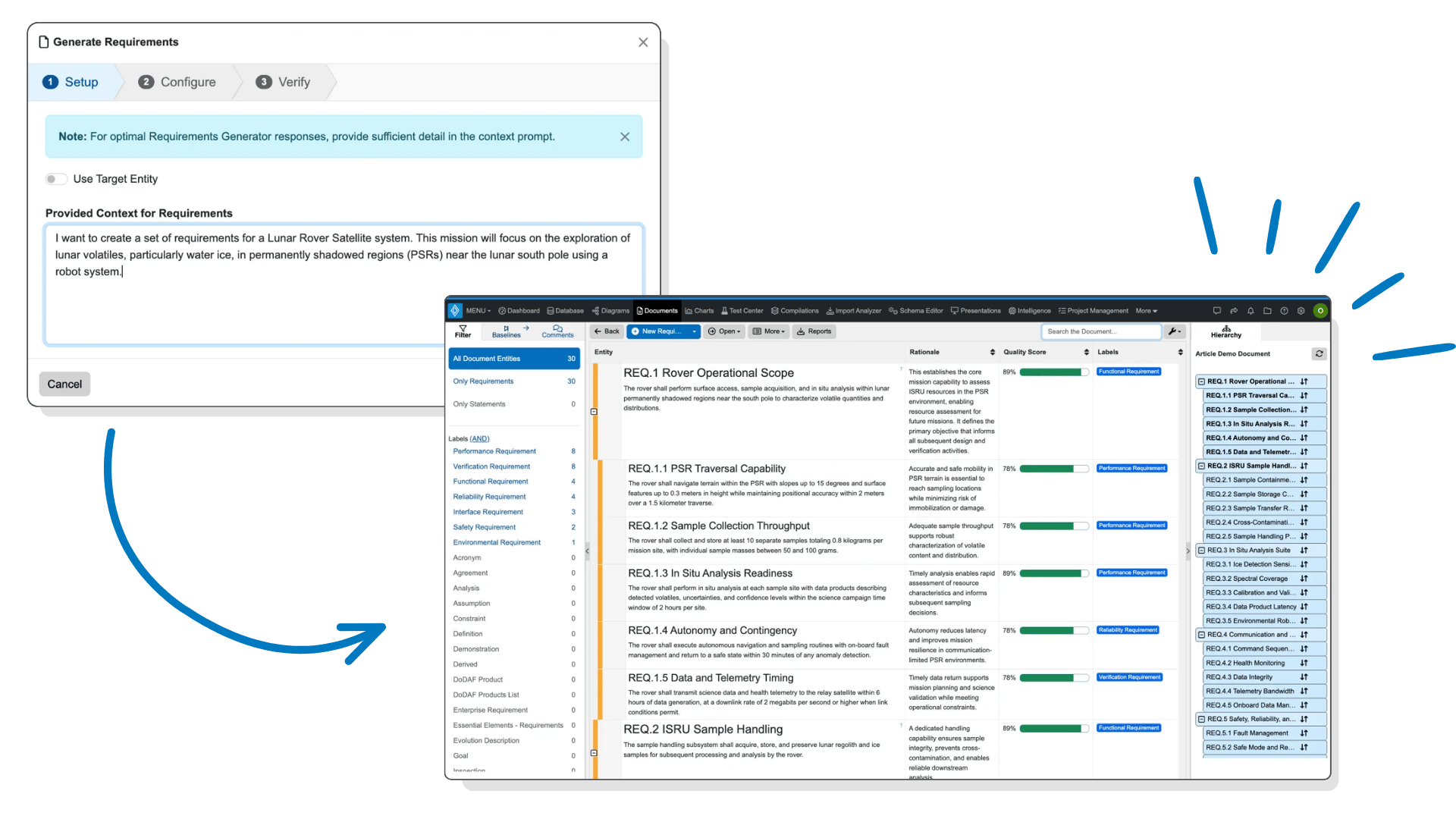
Innoslate's Requirements AI

Innoslate's Requirements AI

From concept to requirements in minutes

Requirements AI helps engineering teams quickly transform concepts, notes, and source material into structured requirements. Spend less time writing and reformatting requirements and more time refining system design.

  • Create requirements faster
  • Improve requirement quality
  • Maintain consistency across projects

ai trust icon

You control the model, access, and data flow.


You can choose the Large-Language Model (LLM) you want to use in Innoslate. We also provide AI integrations for high-security needs.   

Learn more about how we handle AI. →

3. Built-In Natural Language Processing

Improve requirement quality and system structure using native capabilities. se features are built into Innoslate and do not require external AI.

Select an option below:

Quality Check

Improve requirement clarity and testability before they impact your system.

See Quality Check in Action
detect icon
Detect ambiguous language

 Identify vague terms and unclear phrasing before requirements move downstream. 

warning-flag
Flag poor requirements

 Help teams create requirements that are easier to verify and validate. 

identify icon
 Support testable requirements 

 Help teams create requirements that are easier to verify and validate. 

write icon
Reduce rework early in the process

 Catch quality issues during development instead of during review or testing. 

Intelligence View

Improve the total Innoslate project quality heuristic-based dashboard.

See Intelligence View in Action
stars
 Score Model Quality Across Key Categories 

Assess your project across Action, Asset, Conduit, Input/Output, Requirement, Global, and Overall Analysis categories. 

warning
Find Errors and Warnings Faster 

View model issues grouped by heuristic so teams can quickly identify what needs attention.

sliders
 Customize Analysis Rules 

 Adjust heuristics by category and set them as warnings, errors, or ignored based on project needs. 


webpage
 Fix Issues Directly From the Dashboard 

Expand issues, identify affected entities, and fix or ignore findings without manually searching the model.

Traceability Matrix

Traceability Assist builds strong connections. Suspect Assist helps maintain them as your system evolves.

See Traceability Matrix in Action
communities
 Strengthen System Traceability 

 Build connections between requirements, models, and verification artifacts faster. 

knowledge
 Identify Missing Relationships 

 Detect gaps in traceability that could impact analysis or testing. 

user-guide icon
 Track Change Impacts Automatically 

Highlight affected relationships when requirements or system elements change. 


chat
 Maintain System Integrity Over Time 

Help teams maintain accurate traceability as the system evolves.

Implement AI in Your Engineering Workflows

Minimize risks and save time by incorporating AI into your projects.