MIL-STD Templates
Manage, standardize, and streamline your technical data using pre-built templates aligned with military and defense standards. Ensure consistency, traceability, and compliance across the entire system lifecycle.
Key Elements
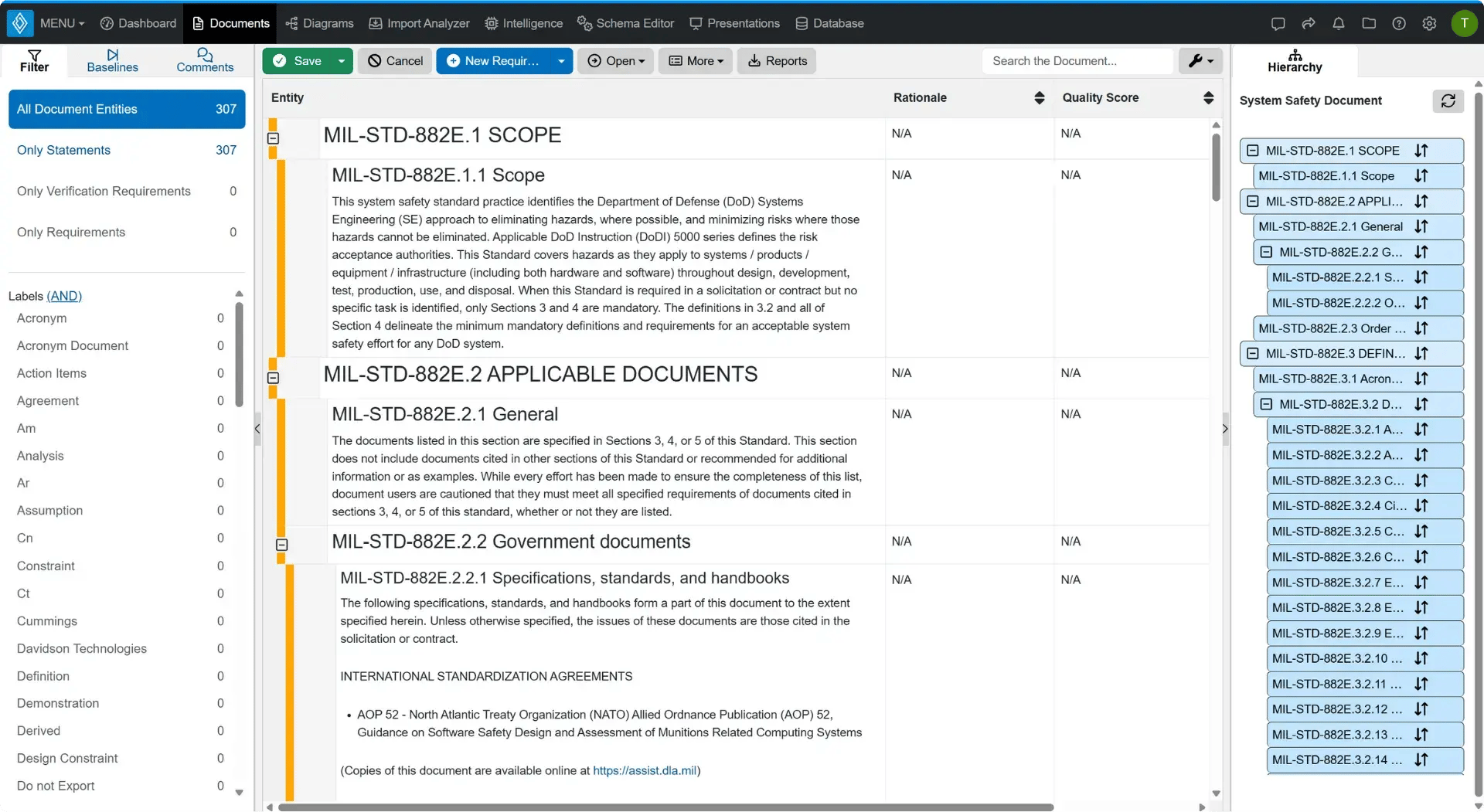
documents dashboard
requirements view
database view
Made For
defense contractors
systems engineers
government
program managers
compliance teams
Available For
Sandbox
Academic
Paid
Specified in Drop-Down
What Is MIL-STD?
MIL-STD refers to Military Standards developed by the U.S. Department of Defense (DoD) to ensure uniform engineering, documentation, and operational practices across defense programs.
What MIL-STD Does
MIL-STD provides a structured approach to managing systems engineering and technical documentation across defense-related efforts. That generally includes:
Standardized documentation: Establishing consistent formats for key artifacts such as system specifications, interface requirements, and verification plans.
Requirements definition: Guiding how requirements are written, organized, and managed to support clarity and traceability.
Process alignment: Ensuring engineering activities follow established DoD practices across the full lifecycle—from concept through deployment and sustainment.
Verification and validation support: Defining expectations for testing, evaluation, and demonstrating that systems meet requirements.
Interoperability and consistency: Enabling teams across different organizations to work together using shared structures and expectations.
Where You Might See MIL-STD?
- DoD acquisition or capability development conversations
- Systems engineering and model-based engineering environments
- Requirements and architecture discussions tied to defense programs
- Documentation efforts requiring standardized formats and compliance
- Cross-organizational collaboration on complex defense systems
Specification Templates Included
Request access to the following parsed specifications.
-
MIL-STD-881F Work Breakdown Structures for Defense Materiel Items
Establishes standardized Work Breakdown Structures (WBS) to support planning, cost estimation, and program management across defense systems.
Available for Academic and Paid only
-
MIL-STD-881E Work Breakdown Structures for Defense Materiel Items
Provides a standardized framework for developing Work Breakdown Structures to support consistent program planning and reporting.
-
MIL-STD-1472G
Provides human engineering criteria to optimize system design for human usability, safety, and performance.
Available for Paid only
-
MIL-STD-1472H
Establishes requirements for preparation and review of military specifications to ensure clarity, consistency, and standardization.
Available for Paid only
-
MIL-STD-464C Template
Defines electromagnetic environmental effects (E3) requirements to ensure systems operate effectively in their intended electromagnetic environments.
-
MIL-STD-461G Template
Establishes electromagnetic interference (EMI) control requirements to ensure equipment operates without causing or suffering interference.
Available for Academic and Paid only
-
MIL-STD-1275E Template
Specifies characteristics of 28-volt DC electrical power provided by military vehicles to ensure compatibility and reliable system performance.
-
MIL-STD-1366E Template
Defines requirements for transportability criteria, ensuring military systems can be efficiently transported via air, land, and sea.
-
MIL-STD-209K Template
Provides requirements for designing and specifying lifting and tie-down provisions to ensure safe handling and transport of military equipment.
-
MIL-STD-3018 (Change-2) Parts Management (02-JUN-2015)
Specifies requirements for managing parts selection and control to ensure reliability, quality, and lifecycle supportability.
-
MIL-STD-882E System Safety
Outlines a systematic approach for identifying, assessing, and mitigating hazards to ensure acceptable levels of risk in defense systems.
-
MIL-STD-2131A Template
Defines procedures for failure reporting, analysis, and corrective action systems (FRACAS) to improve reliability and maintainability.
-
MIL-STD-8591 Template
Provides guidelines for developing and managing testability programs to ensure systems can be effectively tested and diagnosed.
-
MIL-STD-3022 Documentation of Verification, Validation, and Accreditation (VV&A) for Models and Simulations (05-APR-2012) Appendices
Defines documentation requirements for VV&A processes to ensure credibility and proper use of models and simulations.