
Strategic Engineering Decisions With Innoslate Webinar
.svg) SPEC Innovations Team : 9/23/25, 2:45 PM
SPEC Innovations Team : 9/23/25, 2:45 PM
Not in the reading mood? Watch the recording of the webinar!
Rather watch than read? Check out the recording!
What should tomorrow’s systems engineers be learning today? Familiarity with digital engineering tools is useful, but preparing for the workplace also means learning how to ask questions, communicate across disciplines, evaluate information, and respond to feedback.
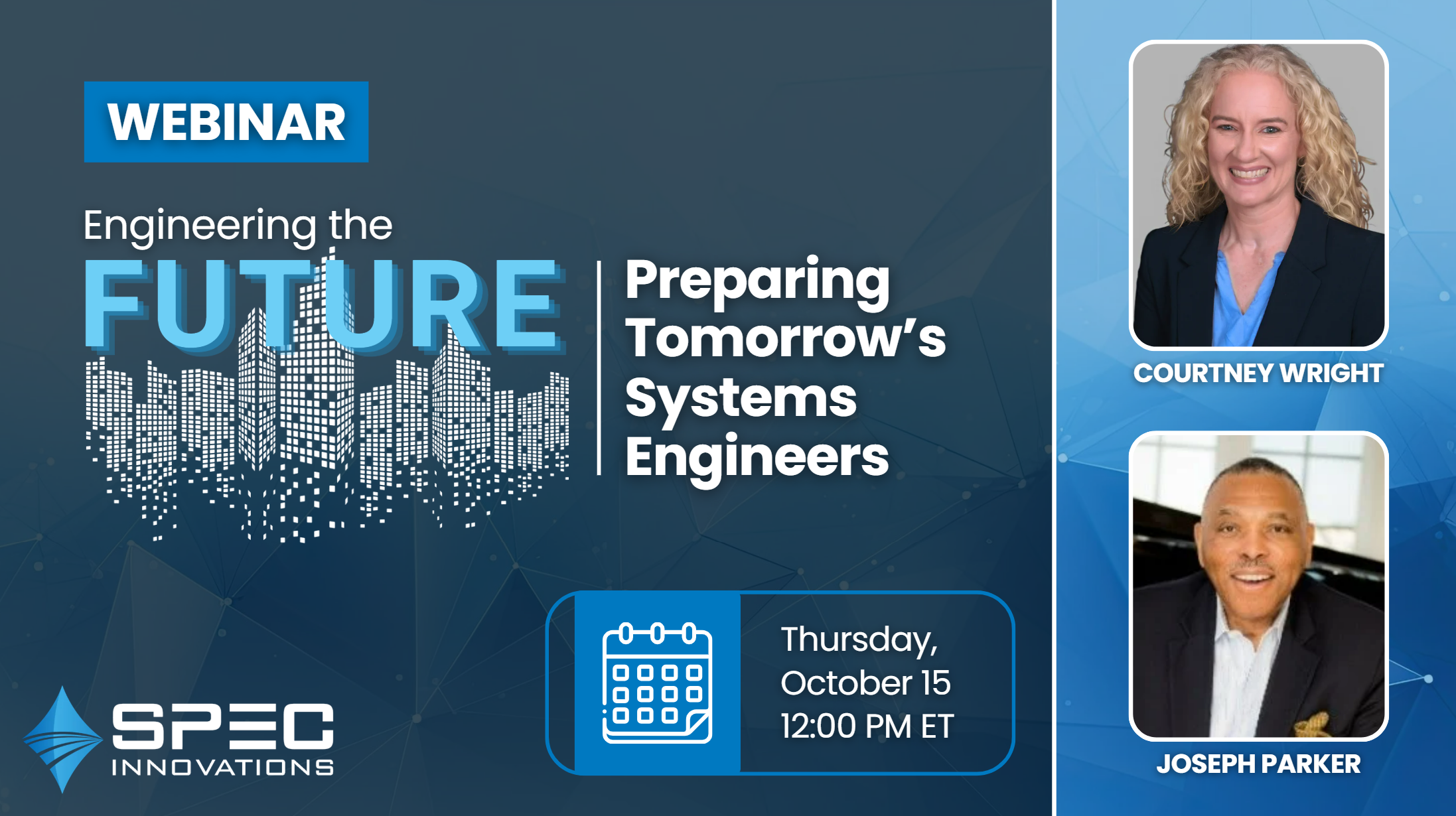
In Part 2 of our Engineering the Future webinar series, Courtney Wright, Director of Solution Engineering at SPEC Innovations, spoke with Joseph Parker, President, CEO, and founder of iN2STEM Solutions, about preparing the next generation of systems engineers. Their conversation explored what employers look for, how engineers develop through experience, and how AI is changing the skills needed on engineering teams.
Below are highlights from their conversation.
In systems engineering and digital engineering roles, how important are tools for workers? If you’re looking to hire someone, if someone’s on your team, how important is it that they know how to use systems engineering tools?
I guess I'm looking more for an inquisitive engineer than someone who’s experienced with tools. I find tools to be like computers or pencils, and they’re just another tool that the engineer gets to add to their toolkit.
Mostly, we want them to explore and see what it is and become proficient with the tool. But tools are not the wherewithal when I’m hiring an engineer.
If you can’t use a tool, that doesn’t stop us from hiring you. We just need you to be inquisitive enough to go after the tool and not expect me to tell you how to use the tool.
If you’re that inquisitive, then you will pick up enough about the tool, and you will enlighten us on how to use the tool based on where you’re coming from.
For Parker, curiosity is an important hiring signal. A candidate may arrive without experience in a particular MBSE platform and still bring the initiative needed to learn it and discover useful applications.
For students and early-career engineers, that suggests a practical way to demonstrate readiness: show how you explored an unfamiliar tool, what you learned, and how you used it to solve a problem.
We try to do just small things. We’ve had young high school engineers, or thought they were engineers, come on board and ask them to model something for me. And they didn’t have a clue what I meant.
Pick something that you know how to do and give us a model of it. And they’ve chosen things from baking apple pies to modeling a video game to a farmer selling eggs, planting corn, building barns, and buying trucks.
Then they run their models and see what the optimization looks like. That’s something that they understand, and then we try to make the transition to what we are doing with them as well.
A familiar process gives beginners a place to start. When learners already understand the activity, they can focus on representing its steps and relationships, and exploring what happens when something changes.
Parker’s examples also show why modeling education can begin before a student has extensive engineering knowledge. The first exercise can build confidence and introduce a way of thinking that learners later apply to more technical problems.
You said that you use tools a little bit differently in your organization than you think people are doing in other organizations. Can you expand on that?
These systems engineering tools, these engineering tools are much more than that. They become the basis for knowledge transfer when people are leaving, and when new people are coming in.
They become the basis for evaluating decisions, risk, and looking at the impact of those things over time, over the lifecycle.
You mentioned that knowledge transfer, whether it be from one employee to another, or to the customers. And I really appreciate that because you’re getting at the principle behind model-based systems engineering. The goal that we have is for everybody to be able to see the relevant data.
Parker illustrated this with a procurement officer who initially doubted she could understand the modeling work. His team used an aerial image of a university campus to introduce its current and future architecture, then explored the departments, activities, and data involved.
Someone shifted away from that in the presentation, and she says, “Can we go back to that diagram? Because I understand that when I see it.”
The usefulness of a model depends partly on whether the people who need it can understand it. An accessible view can help stakeholders connect engineering work to their own responsibilities and questions.
Future systems engineers need practice choosing how to present information to different audiences. That includes helping colleagues and customers understand processes, decisions, and relationships across the lifecycle.
Have you hired non-engineers and brought them over to the dark side?
I didn’t want to because I thought I’d put them out of place. I’m looking for innovative, intelligent, thinking human beings. This is something new for me. Like I said, I always hired engineers in the past.
I’m looking for that creative-oriented young person who sees a different side of the problem than most people. They don’t just see the core problem. They’ll look outside.
The engineering degree, the grade point average, the school where you studied doesn't matter as much if I’m looking for that.
Parker described a colleague with a background in psychology and mathematics, and a master’s degree in cyberpsychology. Her understanding of people helped the team work through resistance to changing established processes.
She has a different conversation than I have with them because she sees the angst and resistance to change. So she’ll feed little pieces of it to them until they can get it.
Different educational backgrounds can contribute useful perspectives to a systems engineering team. Understanding people, organizations, and resistance to change can help a team put technical improvements into practice.
Parker’s experience also suggests employers can learn more about a candidate by exploring how they think and communicate, alongside reviewing their qualifications.
In the middle or later in their career as systems engineers, once some of the basics are in place, what are the next things that challenge people the most?
After Parker discussed the need to look beyond one’s original area of training, Wright raised another challenge for experienced engineers: stepping back so other people can develop.
The stepping away, the delegating, the allowing other folks to make mistakes is kind of the easy way to end that sentence, but I was going to say allowing them to get that scar tissue that is going to make them better. That’s a real hard thing to watch happen.
I think the great thing about research and development for me that I never realized when I left undergraduate school is that you are allowed to fail if you’re willing to experiment.
Until you can fail gracefully somewhere, you think that it’s impossible and that it will kill your career if you fail.
But you’re not failing in areas where you’re trying to operate. You’re trying to fail in those areas where no one has done this before. And that’s the place where I think all of us learn a lot more about our craft than we think we knew before.
Parker distinguished experimentation in research and development from failures in operation. Engineers need opportunities to test unfamiliar ideas, discover limitations, and learn from the results in an appropriate setting.
For senior engineers, developing a team involves deciding where to provide guidance and where to give someone room to work through a problem. That experience can help junior colleagues build judgment and confidence.
Today you have a network that will go far away from what you’re talking about and try to bring information back to answer a question for you. How well can you evaluate what AI is giving you to see if it’s the right answer?
If you give them the opportunity to explore and understand the limitations as well as the reach of it, then I think they will come up with a different way to use it than you would think, and still be successful.
One of the concerns I have is that technology, AI being one piece of that, cannot take the same responsibility a human can. So kind of the authority, the accountability, all of that.
If someone’s going to say, “Oh, well, the AI did it,” I’m not okay with that.
I’m not okay with that either.
If they allowed AI to get the entire answer for them, then they may not understand the reach or the impact. But when you’re in that role of the systems engineer, you have to understand the impact of decisions, changes, and risks that you’re going to take.
The discussion placed evaluation and accountability at the center of AI use. Engineers need to understand the output they use, assess its relevance, and consider the consequences of decisions based on it.
For educators and employers, this creates a development challenge: give engineers experience using AI while ensuring they continue to build the knowledge needed to question its answers.
During the audience Q&A, an attendee asked how engineering programs and employers could prepare engineers to critically evaluate AI-generated work, particularly in safety-critical systems.
When I use an LLM for something that I’m knowledgeable about, I see its weaknesses. But when I use it for something I’m not knowledgeable about, I don’t, but it's probably just as weak.
Those who are trying to learn should practice using it on things that they know the answers to already so they can spot the patterns.
It’s great to have people around you who will be honest with you about what you’ve done.
Be willing to criticize, because criticism is not to hurt; criticism is to build. And if we can criticize to build, then we find that they learn from it and they get better at it over time.
Wright offered a specific learning exercise: use an LLM on a topic you already understand and examine where its answers fall short. Familiarity with the subject makes it easier to recognize mistakes that might otherwise seem convincing.
Peer review and constructive feedback can extend that learning. These practices help engineers develop critical evaluation skills; the conversation did not present them as a complete assurance process for safety-critical work.
What are some ways that mid- and senior-career systems engineers can and should stay relevant?
You’re using the tools, you’re using the capability, and you’re taking a look at the technologies and other things that people are learning.
It’s not just technology, but it’s also how we interact, how we treat one another, how we’re willing to talk to one another about what we learn, and how we share that in an environment where everyone has a voice, even when they don’t have a vote.
I think that becomes a place where everyone gets better at the same time. The senior engineer gets to see pieces he’s never seen before.
In order to keep up with things, don’t just think of them as tools, but look into the applications of them.
One of the things that I’m doing specifically to stay abreast of the technology is to ask people, “How are you using this technology?” Because I’m going to learn it best through those fun applications.
Learning continues throughout an engineering career. Conversations about how colleagues apply technology can reveal useful possibilities and give experienced engineers an accessible way to explore new capabilities.
Parker also emphasized making room for contributions across experience levels. Junior engineers can learn from senior colleagues while introducing ideas and applications those colleagues have not encountered.
There’s been a movement within the systems engineering community to insert systems engineering education in the other engineering degrees. Do you support that? Do you think that’s a good idea?
I think the positive side of systems engineering is picking a language you can use to talk to people.
I had a difficult time conversing in a technical environment with aerodynamic engineers because I didn’t speak in Reynolds numbers. Things that limited what we could do, we did by looking at decibels, or we looked at signal levels and those kinds of things in decibels. But then they didn’t have a clue what we were talking about.
When other engineers can do that and collaborate in those kinds of areas, a lot of learning happens.
I think we become better at it because we have to be able to explain it. And if you don’t know it well, you can’t explain it.
Parker’s answer focused on communication across technical disciplines. Systems engineering education can help students consider how their specialty interacts with other parts of a system and explain those relationships to colleagues.
The discussion also recognized the value of technical depth. A broad view of the system and knowledge of a particular discipline can support each other as engineers work through a problem together.
An audience question asked about community college programs that train people in model-based systems engineering without requiring a bachelor’s degree in engineering.
I love it. I think that this kind of technical role could be a final job for someone. They could do it their whole career. It could be entry-level, and then they get a higher degree, or they move up.
I think it’s a great starter role or kind of technician role. What are your thoughts?
I want to agree, but at the same time, I want someone who has a little bit of that in their background because without that, there are some things you just will not recognize, will not understand.
There are some high schools doing model-based systems engineering areas as well, and getting in these career technical education courses, getting people to be able to use model-based systems engineering tools to do things they would not have ever thought to do.
Anything you can give them where they can experience that before they get to do the other things, I think that’s fine. I think it’s a great thing to do.
Wright saw value in community college pathways for modeling roles, whether someone builds a career in that role or continues into further education and responsibilities.
Parker supported early exposure while emphasizing that foundational knowledge helps people recognize and understand technical issues. Together, their answers suggest matching preparation and support to the work a person will perform.
Do you think that we’re moving in the direction where MBSE tools, digital engineering tools, are going to be like Microsoft and Google tools, where it’s just what you do?
Tools are just a part of what you do, but they make you better at what you do.
The tools just become that knowledge base that will follow you throughout what you do. And having that knowledge base being something that people from multiple backgrounds can understand, I think, is important.
For the tools to not just have us do something faster, but to just do it better, to be coming up with insights that are either deeper than we as humans were going to have or are broader because it’s a scale. It’s looking at 500 requirements or 5,000 requirements, and my brain maybe can’t remember the difference between that many.
Their discussion pointed toward tools becoming an ordinary part of engineering work, supporting a shared knowledge base that teams can revisit as solutions evolve.
Preparing engineers for that environment involves teaching them to use information across the lifecycle, understand relationships, and draw useful insights from models and requirements.
Throughout the conversation, Parker returned to curiosity and the willingness to learn. Those qualities help people explore unfamiliar tools, bring diverse perspectives, and grow through feedback and experience.
For educators and employers, the discussion suggests connecting instruction with opportunities to apply it. Modeling a familiar activity, explaining technical work to another discipline, and reviewing AI output all give learners a chance to practice the judgment their future roles will require.
This webinar was Part 2 of SPEC Innovations’ Engineering the Future series.
Explore the full Engineering the Future webinar series for more conversations about the education, skills, and technologies shaping systems and digital engineering.
Missed Part 1? Read Career Paths in Systems and Digital Engineering for Courtney Wright’s conversation with Nicole Hutchison about entering the profession and developing throughout a career.
You can also join Ask a Systems Engineer, SPEC Innovations’ weekly live session, to bring your questions about systems engineering, MBSE, digital engineering, and career development.
SPEC Innovations Team : 9/23/25, 2:45 PM
Not in the reading mood? Watch the recording of the webinar!
SPEC Innovations Team : 10/21/25, 3:31 PM
Don't feel like reading? Watch the webinar recording!
.png)
 John Schatz III : 8/21/24, 10:43 AM
Want to sit back, relax, and listen? Watch the webinar recording!