Digital Engineering Glossary
Explore the terminology that powers modern digital engineering.
Explore the terminology that powers modern digital engineering
Digital engineering brings together models, data, software, standards, and collaboration to improve how complex systems are designed, developed, tested, and sustained. Whether you're new to digital engineering or looking for a quick reference, this glossary explains the most common concepts used throughout the engineering lifecycle.
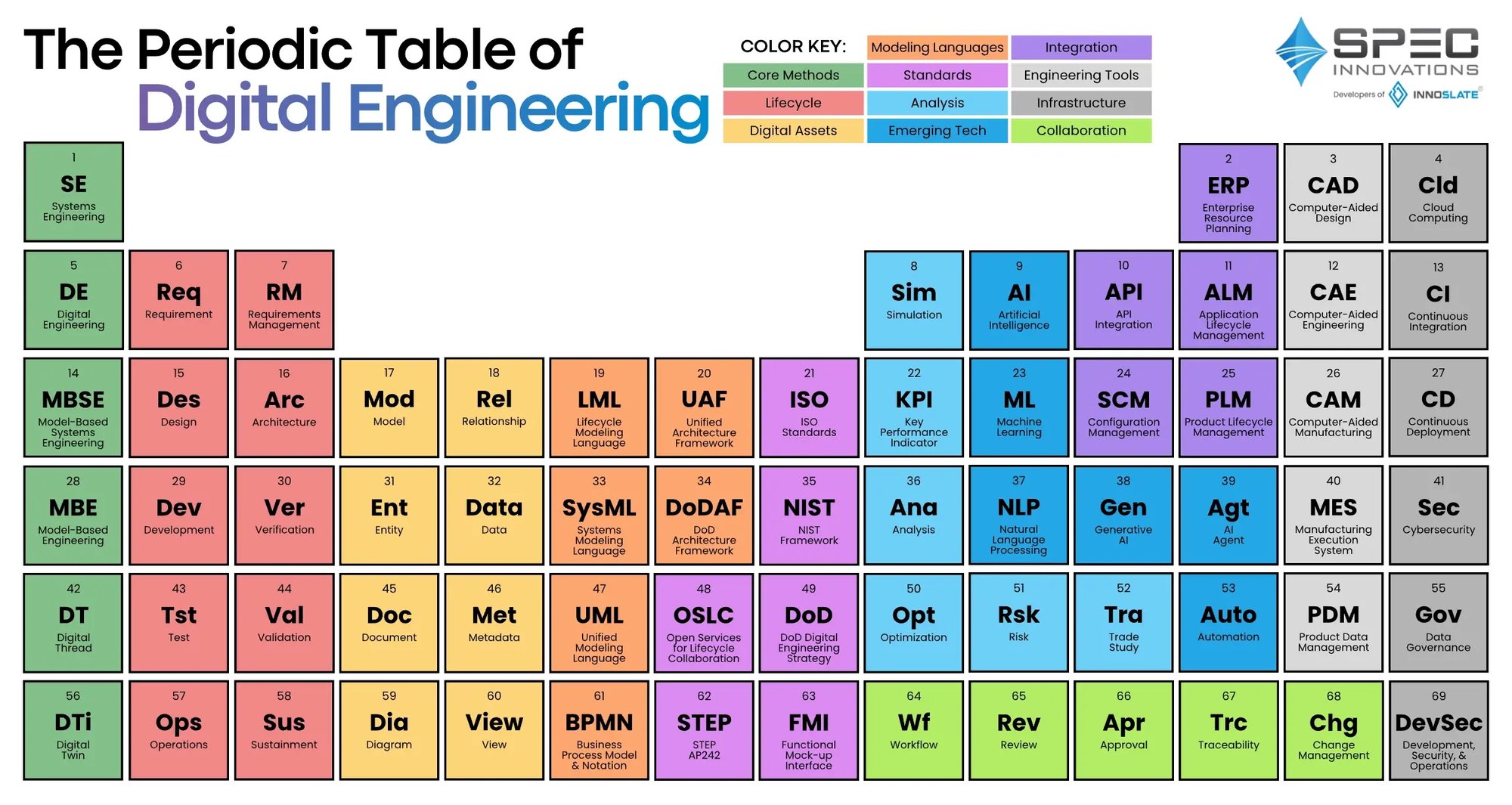
Use the Digital Engineering Periodic Table below to explore key concepts, then browse the definitions organized by category. Throughout this glossary, you'll also find links to related resources, best practices, and Innoslate capabilities.
-
Digital Engineering (DE)
A modern engineering approach that uses connected digital data, models, and processes throughout the lifecycle of a system. Digital engineering improves collaboration, decision-making, traceability, and lifecycle management by replacing disconnected documents with integrated digital information.
-
Model-Based Systems Engineering (MBSE)
A systems engineering methodology that uses digital models as the primary source of engineering information instead of relying primarily on documents. MBSE improves communication, reduces errors, and maintains traceability across the system lifecycle.
-
Model-Based Engineering (MBE)
An engineering approach that extends model-based practices beyond systems engineering into disciplines such as mechanical, electrical, manufacturing, and software engineering.
- Digital Thread (DT)
-
Digital Twin (DTI)
Digital Twin (DTI)
A virtual representation of a physical product or system that stays synchronized with operational or simulated data. Digital twins help organizations monitor performance, predict maintenance needs, and evaluate future scenarios.
-
Systems engineering (SE)
Systems Engineering (SE)
An interdisciplinary engineering discipline focused on defining customer needs, balancing technical tradeoffs, and delivering successful systems throughout their lifecycle.
-
Requirements Management (RM)
The process of capturing, organizing, analyzing, tracing, verifying, and maintaining requirements throughout a project's lifecycle.
-
Requirement (REQ)
Requirement (REQ)
A documented capability, function, constraint, or performance expectation that a system must satisfy.
-
Architecture (ARC)
Architecture (ARC)
The logical and physical structure of a system, including its components, interfaces, behaviors, and relationships.
-
Design (DES)
Design (DES)
The process of translating system requirements and architecture into detailed technical solutions that can be implemented.
-
Development (DEV)
Development (DEV)
The creation and implementation of hardware, software, and system components according to approved designs.
-
Test (TST)
Test (TST)
Activities that evaluate whether a system performs as expected under specified conditions.
-
Verification (VER)
Verification (VER)
The process of confirming that the system was built correctly according to its requirements.
-
Validation (VAL)
Validation (VAL)
The process of determining whether the completed system fulfills stakeholder needs and intended operational use.
-
Operations (OPS)
Operations (OPS)
The phase in which the system is deployed and performs its intended mission or business function.
-
Sustainment (SUS)
Sustainment (SUS)
Activities that maintain, upgrade, and support a system throughout its operational life.
-
Model (MOD)
Model (MOD)
A structured representation of a system that captures its requirements, behavior, architecture, interfaces, or performance.
-
Entity (ENT)
Entity (ENT)
An individual object within a digital model that represents a requirement, component, function, interface, risk, test, or another engineering artifact.
-
Document (DOC)
Document (DOC)
Human-readable engineering documentation that can be generated from or synchronized with digital model data.
-
Diagram (DIA)
Diagram (DIA)
A graphical representation of engineering information that helps communicate system structure, behavior, relationships, or processes.
-
View (VIEW)
View (VIEW)
A filtered presentation of model information tailored to a particular stakeholder or engineering discipline.
-
Data (DATA)
Data (DATA)
Structured engineering information that supports analysis, collaboration, and lifecycle management.
-
Relationship (REL)
Relationship (REL)
A connection between two engineering objects that enables traceability and impact analysis.
-
Metadata (META)
Metadata (META)
Information that describes other engineering data, such as authorship, version, status, ownership, or classification.
-
Operations (OPS)
Operations (OPS)
The phase in which the system is deployed and performs its intended mission or business function.
-
Sustainment (SUS)
Sustainment (SUS)
Activities that maintain, upgrade, and support a system throughout its operational life.
-
LML
LML
The Lifecycle Modeling Language was developed specifically for systems engineering and lifecycle communication.
Learn More: How Lifecycle Modeling Language (LML) Supports Application Lifecycle Management (ALM) →
-
SysML
SysML
The Systems Modeling Language used to describe system requirements, structure, behavior, and parametrics.
-
UML
UML
The Unified Modeling Language is commonly used for software architecture and object-oriented design.
-
BPMN
BPMN
Business Process Model and Notation, a standard for modeling organizational workflows and business processes.
-
UAF
UAF
The Unified Architecture Framework, which supports architecture development across defense, government, and commercial enterprises.
-
DoDAF
DoDAF
The Department of Defense Architecture Framework is used to describe defense architectures and capabilities.
-
STEP AP242 (STEP)
STEP AP242
An ISO standard for exchanging engineering product data between CAD, PLM, and manufacturing systems.
-
Functional Mock-up Interface (FMI)
An open standard for exchanging simulation models between engineering software applications.
-
Open Services for Lifecycle Collaboration (OSLC)
A standard that enables engineering and lifecycle management tools to exchange linked information.
-
ISO Standards (ISO)
ISO Standards
International standards that define best practices for quality, safety, security, and engineering management.
-
NIST Framework (NIST)
NIST Framework
Guidance developed by the National Institute of Standards and Technology to improve cybersecurity and digital system resilience.
-
DoD Digital Engineering Strategy (DoD)
The U.S. Department of Defense's strategic vision for transforming engineering through digital models, integrated data, and modern engineering practices.
-
Simulation (SIM)
Simulation (SIM)
The execution of digital models to evaluate system behavior before physical implementation.
Learn more: Model Simulation →
-
Analysis
Analysis (ANA)
The evaluation of engineering information to support technical decisions throughout development.
-
Optimization (OPT)
Optimization (OPT)
The process of improving a design or process to achieve the best possible performance while satisfying constraints.
-
Trade Study (TRA)
Trade Study (TRA)
A structured comparison of multiple alternatives to determine the most effective engineering solution.
-
Risk (RSK)
Risk (RSK)
The identification, assessment, and management of technical, schedule, cost, or operational uncertainties.
-
Performance Metric (KPI)
A measurable indicator used to evaluate system performance, engineering progress, or project success.
-
Artificial Intelligence (AI)
Computer systems that perform tasks requiring human intelligence, such as reasoning, prediction, and content generation.
-
Generative AI (GEN)
Generative AI (GEN)
AI systems that create text, images, software code, engineering content, or other original outputs.
-
Natural Language Processing (NLP)
AI techniques that understand and analyze human language to automate engineering tasks such as requirements quality checks and document analysis.
-
Machine Learning (ML)
Algorithms that learn patterns from data to improve predictions and automate decision-making.
-
AI Agent (AGT)
AI Agent (AGT)
An autonomous software assistant capable of planning, reasoning, and performing engineering tasks with minimal human guidance.
-
Automation (AUTO)
Automation (AUTO)
The use of software and workflows to perform repetitive engineering activities more efficiently and consistently.
-
API Integration (API)
Software interfaces that allow different engineering applications to exchange information automatically.
-
Product Lifecycle Management (PLM)
Systems that manage product information from concept through manufacturing and retirement.
-
Application Lifecycle Management (ALM)
Software used to manage software development activities throughout the application lifecycle.
-
Configuration Management (SCM)
Processes that control versions, changes, and baselines of engineering artifacts.
-
Enterprise Resource Planning (ERP)
Business software that manages finance, procurement, manufacturing, inventory, and other enterprise operations.
-
Computer-Aided Design (CAD)
Software used to create detailed 2D and 3D engineering designs.
Learn More: A Quick Guide to CAD for Model-Based Systems Engineering →
-
Computer-Aided Engineering (CAE)
Engineering software used for simulation, structural analysis, thermal analysis, and other technical evaluations.
-
Computer-Aided Manufacturing (CAM)
Software that translates engineering designs into manufacturing instructions.
-
Manufacturing Execution System (MES)
Systems that monitor, control, and optimize manufacturing operations.
-
Product Data Management (PDM)
Software that organizes engineering files, revisions, and product documentation.
-
Cloud Computing (CLD)
On-demand computing resources that provide scalable engineering environments and collaboration.
-
DevSecOps (DEVSEC)
DevSecOps (DEVSEC)
A software development approach that integrates development, cybersecurity, and operations throughout delivery.
-
Continuous Integration (CI)
The practice of automatically integrating and testing software changes as they are developed.
-
Continuous Deployment (CD)
The automated release of validated software into production environments.
-
Cybersecurity (SEC)
Cybersecurity (SEC)
The protection of engineering systems, software, and data from unauthorized access or attack.
-
Data Governance (GOV)
Policies and processes that ensure engineering data remains accurate, secure, consistent, and compliant.
-
Collaboration (COL)
Collaboration (COL)
The coordinated work of multidisciplinary teams using shared engineering information and digital models.
-
Workflow (WF)
Workflow (WF)
A structured sequence of engineering activities that guides work from initiation to completion.
-
Review (REV)
Review (REV)
The evaluation of engineering artifacts to verify technical quality and readiness.
-
Approval (APR)
Approval (APR)
Formal authorization indicating that engineering work meets required standards and can proceed to the next phase.
-
Traceability (TRC)
Traceability (TRC)
The ability to follow relationships between requirements, models, design elements, tests, risks, and other engineering artifacts throughout the lifecycle.
-
Change Management (CHG)
A disciplined process for evaluating, approving, implementing, and documenting changes to engineering information while maintaining configuration control.
Get digital. Get connected. Get Innoslate free.
A digital engineering platform that combines project management, model-based systems engineering, and requirements management, along with strong integration to help engineers get their job done.