A single poorly written requirement can seem harmless during planning. In fact, many bad requirements go unnoticed at first because they appear reasonable on the surface.
The real cost often emerges later.
An ambiguous requirement may be interpreted differently by engineers, testers, suppliers, and stakeholders. A requirement without measurable criteria may be impossible to verify. A requirement that lacks traceability may create confusion when changes occur.
For complex systems, even small requirement issues can ripple through design, development, testing, compliance, and operations. This is one reason why effective requirements management is critical for reducing risk and maintaining alignment throughout the lifecycle.
What starts as a minor documentation problem can quickly become a source of schedule delays, rework, budget overruns, and stakeholder dissatisfaction.
Why Requirements Matter More Than Most Teams Realize
Requirements serve as the foundation for nearly every engineering decision. Strong requirements management practices help organizations maintain clarity, consistency, and traceability as requirements evolve.
Different requirements types influence different aspects of development. Stakeholder requirements define business needs, system requirements guide design decisions, and verification requirements help ensure the delivered solution can be tested and validated.
Problems within any of these requirements types can create downstream cost and risk.
They influence:
System architecture
Design decisions
Development priorities
Testing activities
Verification planning
Compliance efforts
When requirements are clear and traceable, teams can move forward with confidence. When requirements are unclear or incomplete, uncertainty spreads throughout the lifecycle.
The challenge is that requirement problems often remain hidden until much later in development, when corrections become significantly more expensive.
A Simple Example of a Bad Requirement
Consider the following requirement:
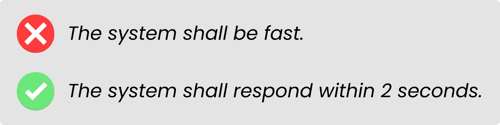
The system shall provide fast response times.
At first glance, this seems reasonable. However, the word fast means different things to different people.
One engineer may design for a two-second response. Another may assume five seconds is acceptable. A tester may have no objective way to determine whether the requirement has been satisfied.
Now imagine this requirement has already influenced:
System architecture
User interface design
Network design
Verification plans
By the time the ambiguity is discovered, multiple teams may need to revisit their work.
Poor requirements rarely create isolated problems. Instead, they tend to trigger a chain reaction throughout the lifecycle.
The impact can vary depending on the requirements type involved. Ambiguity in stakeholder requirements may lead to misaligned expectations, while unclear system or interface requirements can affect design, integration, and verification activities.
Requirement
The system shall provide fast response times.
Design Interpretation
Different teams make different assumptions.
Development
Features are implemented based on those assumptions.
Verification
Testing teams discover no measurable acceptance criteria exist.
Rework
Requirements, designs, and tests must be updated.
Schedule and Cost Impact
The program experiences delays, increased costs, and additional risk.
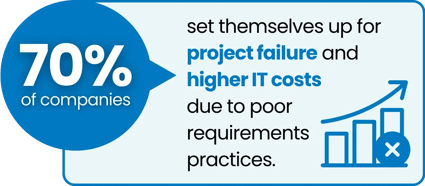
Poor requirements have long been recognized as a major contributor to project challenges and failures. Industry research consistently shows that unclear, incomplete, and poorly managed requirements contribute to cost overruns, schedule delays, and stakeholder dissatisfaction.
Because requirements influence nearly every engineering and project decision, even small requirement issues can create significant downstream consequences when left unresolved.
The later an issue is discovered, the more expensive it becomes to resolve.
Common Costs of Bad Requirements
Increased Engineering Rework
One of the most visible consequences of poor requirements is rework. When requirements are unclear, teams often build solutions that must later be redesigned or modified.
This can impact:
Architecture
Software development
Hardware design
Integration activities
Verification planning
The result is additional effort that could have been avoided with better-quality requirements up front.
Schedule Delays
Requirement issues frequently surface during reviews, integration, or testing. When requirements must be revised late in development, dependent activities often need to be updated as well.
This can delay:
Design reviews
Integration events
Verification testing
Program milestones
Product releases
Verification Challenges
Requirements should provide clear acceptance criteria. Without measurable and testable requirements, verification teams may struggle to determine whether the system satisfies stakeholder expectations.
This often creates disputes during testing and acceptance reviews.
In regulated industries, poor requirements can create significant compliance challenges. Requirements that lack traceability, approval history, or verification evidence may become difficult to defend during audits or certification reviews.
Organizations may find themselves spending substantial effort gathering documentation that should have been maintained throughout development.
Many of these challenges are not simply requirement-writing problems; they are requirements management problems that become more difficult and expensive to address as projects progress.
Industry Insight
According to research from IAG Consulting, organizations that improve requirements practices often see significant gains in project performance, while poor requirements continue to be a major contributor to project challenges, rework, and budget overruns. This highlights why investing in requirement quality early can have an outsized impact on project success.
Why Ambiguity Is So Expensive
Among all quality issues in requirements, ambiguity is often the most costly.
Ambiguous requirements lead to multiple interpretations, so different teams may move in different directions without realizing it.
Common examples include terms such as:
Fast
Easy to use
Reliable
Flexible
Efficient
User-friendly
These terms may sound reasonable, but they provide little guidance for implementation or verification.
Replacing subjective language with measurable criteria dramatically reduces risk.
One reason bad requirements become expensive is that organizations often lack visibility into where those requirements are used. Effective requirements management relies on traceability to maintain these relationships and provide visibility throughout the system lifecycle.
Effective traceability is especially important when managing multiple requirements types because relationships often exist between stakeholder requirements, system requirements, derived requirements, and verification activities.
With traceability, they can quickly identify affected artifacts and make informed decisions. This helps reduce both risk and rework.
💡 Pro Tip: Innoslate has a Requirements Traceability Matrix that helps track requirements throughout the project lifecycle. Learn more
Preventing Bad Requirements Before They Become Expensive
Preventing costly requirement issues starts with understanding what separates good requirements from bad ones.
Effective requirements management combines strong requirement-writing practices with processes that support traceability, collaboration, change control, and verification. Together, these practices help teams identify issues early, when they are easier, faster, and less expensive to resolve.
By focusing on both requirement quality and lifecycle visibility, organizations can reduce risk, improve project outcomes, and avoid many of the costly consequences associated with poor requirements.
Organizations can reduce requirement-related risk by focusing on a few core practices.
Write Clear and Measurable Requirements
Avoid vague language and include objective criteria whenever possible.
Connect requirements to stakeholder needs, architecture elements, risks, and verification activities.
Establish Requirement Reviews
Cross-functional reviews help identify ambiguity and conflicts before they become larger issues.
Manage Requirements as Connected Data
Treating requirements as isolated documents often limits visibility and increases maintenance effort. Modern requirements management approaches connect requirements directly to architecture, verification, and decision-making activities.
How Innoslate Helps Prevent Requirement Problems
Preventing bad requirements is easier when teams can see how requirements relate to the broader system.
Innoslate helps organizations manage requirements as connected engineering data rather than isolated documents.
Teams can:
Maintain end-to-end traceability
Link requirements to architecture and system models
This visibility helps teams identify potential issues earlier, understand downstream impacts, and maintain alignment throughout development.
Instead of discovering requirement problems during integration or testing, organizations can address them while changes are still manageable.
Small Requirement Problems Rarely Stay Small
A poorly written requirement may seem like a minor issue when viewed in isolation.
But requirements sit at the center of engineering, verification, compliance, and decision-making activities. When the quality of requirements suffers, the effects often spread throughout the program.
The cost of a bad requirement rarely ends with the requirement itself.
By focusing on requirement quality, traceability, and lifecycle visibility, organizations can reduce risk, minimize rework, and improve confidence that delivered systems meet stakeholder expectations.
A bad requirement is one that is unclear, ambiguous, subjective, incomplete, or difficult to verify. Poorly written requirements often lead to misunderstandings, design errors, testing challenges, and costly rework throughout development.
Bad requirements can increase project costs by creating rework, delaying schedules, complicating testing activities, and introducing compliance risks. The later a requirement issue is discovered, the more expensive it typically becomes to resolve.
Ambiguous requirements allow different stakeholders, engineers, and testers to interpret expectations differently. This can result in inconsistent implementations, failed verification activities, and stakeholder dissatisfaction.
Traceability connects requirements to stakeholder needs, architecture, design decisions, test cases, and verification evidence. This visibility helps teams identify impacts early and reduces the likelihood that requirement issues go unnoticed.
Good requirements are typically clear, measurable, testable, feasible, necessary, and traceable. These qualities help ensure requirements can guide development and be objectively verified throughout the lifecycle.
Have questions about model-based systems engineering or requirements management? Talk to an expert and see how Innoslate can streamline your projects from start to finish.
Before a team can design the right system, product, or solution, it needs to understand what stakeholders actually need. That sounds straightforward,...

.svg) Steven Dam
Steven Dam
.webp?width=910&height=66&name=Cost%20of%20Bad%20Requirements%20Flowchart%20(2).webp)
 Poor requirements have long been recognized as a major contributor to project challenges and failures.
%20(1).webp?width=1920&height=975&name=Impact%20Analysis%20screenshot%20in%20innoslate%20(1)%20(1).webp)


.svg) SPEC Innovations Team : 10/6/26, 3:46 PM
SPEC Innovations Team : 10/6/26, 3:46 PM

.svg)
.jpg?width=30&name=1654525569992%20(1).jpg)