Career Paths in Systems & Digital Engineering Webinar
.svg) SPEC Innovations Team : 9/11/26, 3:58 PM
SPEC Innovations Team : 9/11/26, 3:58 PM
Rather watch than read? Check out the recording!
Modern engineering projects generate thousands of interconnected pieces of information. Stakeholder needs evolve, requirements change, architectures mature, interfaces are refined, tests are executed, and risks emerge throughout development.
The challenge isn't creating these engineering artifacts; it's understanding how every change affects the rest of the system.
That's why end-to-end traceability has become a foundational principle of requirements management, systems engineering, and digital engineering. Rather than treating requirements, models, and verification activities as isolated documents, end-to-end traceability connects them into a single, living engineering knowledge base.
In this article, you'll learn what end-to-end traceability is, why traditional traceability methods often fail, best practices for maintaining traceability throughout the lifecycle, and how Innoslate simplifies traceability with a connected digital thread.
End-to-end traceability is the ability to follow engineering information throughout the entire system lifecycle, from the earliest stakeholder need to the final disposal of the system.
In requirements management, traceability ensures that every requirement can be connected to its source, implementation, verification, and any downstream engineering artifacts it affects. This visibility helps teams manage change while maintaining confidence that stakeholder needs are being met.
Rather than linking only requirements to test cases, complete traceability connects every major engineering artifact. For example:
.webp?width=910&height=163&name=End-to-End%20Traceability%20Flowchart%20(1).webp)
Because these relationships are maintained throughout development, engineers can quickly determine where a requirement originated, how it has been implemented, what systems it affects, and whether it has been successfully verified.
This bidirectional traceability provides confidence that every engineering decision remains connected to its original purpose.
Many organizations still manage traceability using spreadsheets, manually maintained traceability matrices, or disconnected documents.
While these approaches may work on smaller projects, they become increasingly difficult to maintain as system complexity grows.
Common challenges include:
Manually updating traceability matrices
Broken links after requirements change
Duplicate or conflicting information
Difficulty performing impact analysis
Limited collaboration across engineering teams
Poor visibility into verification status
As projects scale, maintaining traceability manually often becomes a full-time effort, increasing the likelihood of missed dependencies and costly rework.
Modern digital engineering replaces static traceability documents with continuously connected engineering data. Organizations across government and industry are increasingly adopting model-based engineering and digital engineering approaches to improve collaboration, reduce manual processes, and maintain connected engineering information.
Creating effective traceability isn't about documenting more information; it's about connecting information in meaningful ways.
Every requirement should exist for a reason. NASA's Systems Engineering Handbook recommends establishing traceability from stakeholder expectations through technical requirements and verification activities to help ensure the delivered system satisfies its intended mission.
The most effective engineering projects begin by capturing stakeholder needs, operational concepts, business objectives, or mission goals before creating detailed requirements.
Maintaining these relationships ensures every requirement can always be traced back to its original intent.
With Innoslate, stakeholder needs can be linked directly to system requirements, preserving complete traceability from the beginning of development.
📖 Related Reading: 9 Ways to Align Requirements With Stakeholder Needs
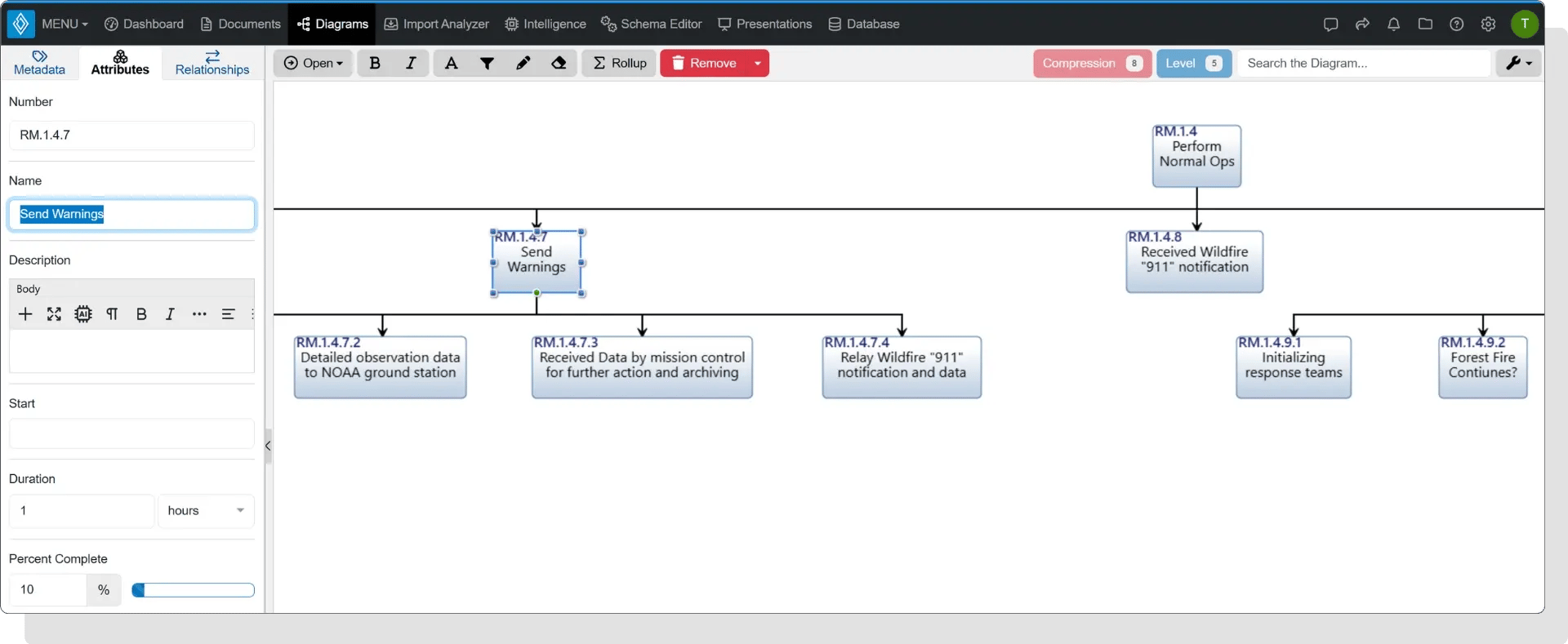
Requirements rarely exist independently. A well-structured hierarchy is one of the foundations of successful requirements management because it allows teams to organize, allocate, and trace requirements across every level of the system.
High-level mission requirements are typically decomposed into system, subsystem, software, hardware, and component-level requirements.
Maintaining this hierarchy helps engineering teams understand:
Requirement ownership
System decomposition
Requirement allocation
Coverage across the system architecture
Instead of manually tracking these relationships, Innoslate automatically maintains requirement hierarchies through linked entities, making it easier to navigate complex systems.
Requirements define what a system must accomplish, but architecture describes how the system achieves those objectives. Connecting these disciplines provides one of the greatest advantages of Model-Based Systems Engineering (MBSE).
The Systems Engineering Body of Knowledge (SEBoK) describes MBSE as an approach for improving communication, consistency, and lifecycle integration by using models as authoritative engineering artifacts.
Requirements can be linked directly to:
Logical architecture
Physical architecture
Functional decomposition
Interfaces
Components
Mission models
These relationships allow engineers to quickly determine which architectural elements satisfy each requirement.
As the architecture evolves, the traceability remains intact.

True end-to-end traceability works in both directions. Rather than only tracing from requirements to implementation, engineers should also be able to navigate backward from any artifact to understand why it exists.
For example, an engineer should be able to move from:
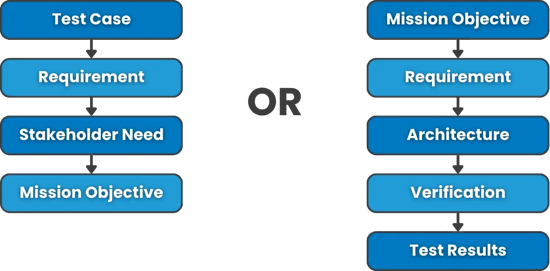
This bidirectional navigation makes audits, design reviews, and engineering analyses significantly easier.
Bidirectional traceability also supports more iterative development approaches. Rather than treating systems engineering as a strictly linear process, Agile systems engineering relies on continuous feedback between stakeholder needs, functional analysis, architecture, verification, operations, and support.
Engineering teams frequently move both forward and backward through these activities, refining requirements as their understanding of the system evolves. Maintaining bidirectional traceability ensures every decision remains connected to its source and downstream implementation, even as the design changes over time.
In Innoslate, these relationships remain connected across the engineering lifecycle, allowing users to navigate between related entities without maintaining separate traceability documents.
📖 Related Reading: Agile Systems Engineering Using the Middle-Out Process
Requirements inevitably change. One of the primary goals of modern requirements management is understanding how those changes affect the rest of the system before implementation begins.
Without traceability, changing a single requirement may unexpectedly affect:
Architecture models
Interface definitions
Verification procedures
Test cases
Risks
Documentation
Downstream requirements
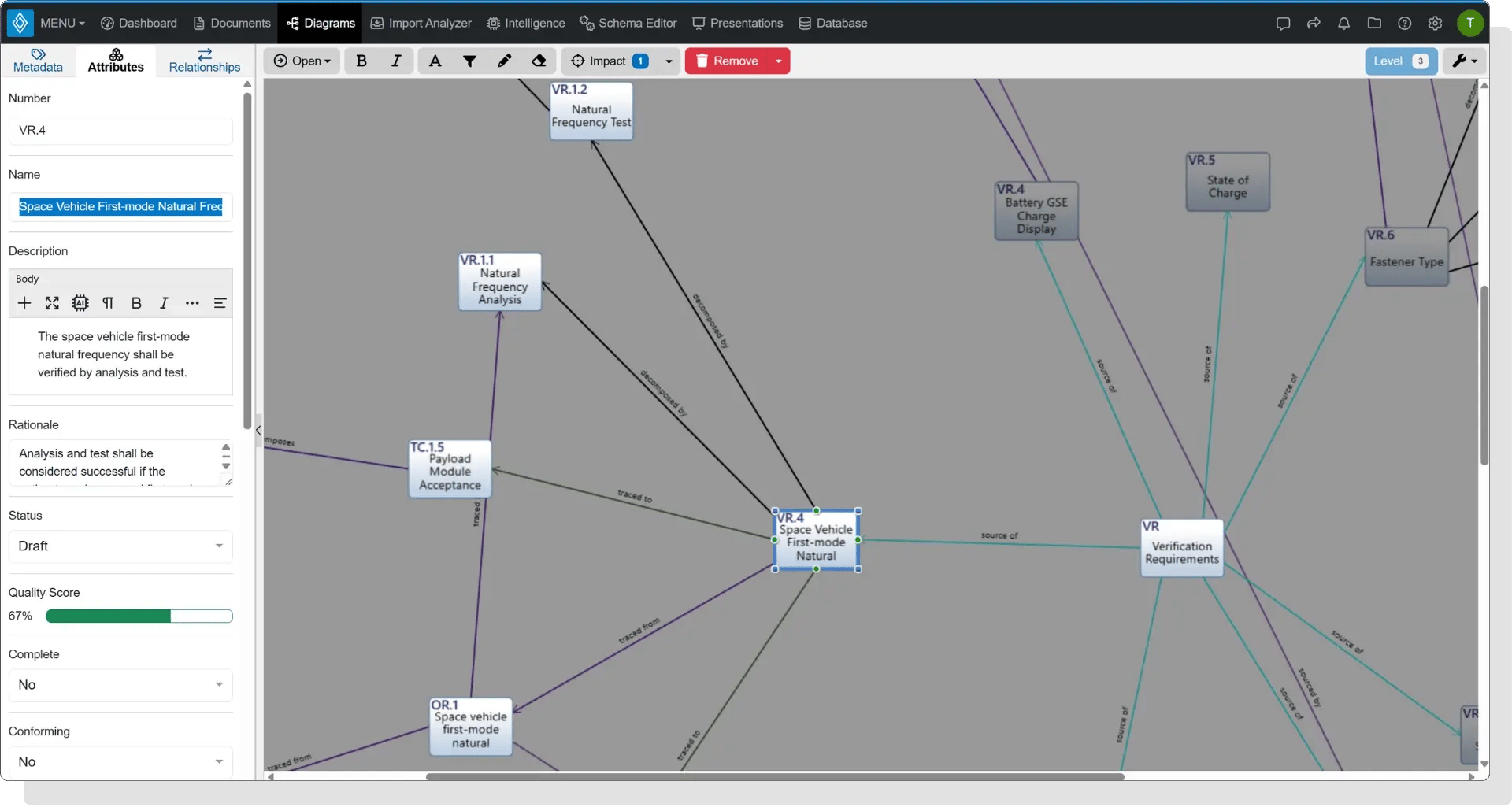
Modern engineering platforms allow teams to visualize these dependencies immediately.
In Innoslate, engineers can examine connected relationships before approving changes, helping identify downstream impacts early and reducing costly surprises later in development.
A requirement isn't complete until it has been verified. Lifecycle standards such as ISO/IEC/IEEE 15288 emphasize verification and validation (V&V) activities throughout the system lifecycle as an essential part of systems engineering.
End-to-end traceability extends beyond design activities to include V&V. Each requirement should be connected to the:
Verification method
Test case
Verification event
Test results
Verification status
This provides immediate visibility into which requirements have been satisfied and which still require validation.
Because these relationships remain connected, engineering teams can quickly demonstrate compliance during design reviews, customer audits, or certification activities.
📖 Related Reading: How to Verify and Validate Requirements
One of the biggest misconceptions about traceability is that it only applies to requirements. In reality, modern digital engineering connects far more than requirements alone.
The U.S. Department of Defense's Digital Engineering Strategy promotes maintaining an authoritative source of truth that connects engineering information across the entire lifecycle through an integrated digital thread.
A complete digital thread may include relationships between:
Requirements
Architecture models
Mission models
Interfaces
Risks
Decisions
Action items
Documents
Verification artifacts
Simulations
Baselines
AI-generated engineering artifacts
These interconnected relationships provide engineers with a comprehensive understanding of the system throughout its lifecycle.
Innoslate enables organizations to manage all these engineering artifacts within a single collaborative environment, creating a living digital thread rather than isolated engineering documents.
Maintaining traceability manually becomes increasingly difficult as projects grow. Innoslate simplifies this process by connecting engineering information in a single cloud-native platform. Key capabilities include:
Create and manage relationships between requirements, architecture, verification activities, risks, and other engineering artifacts without relying on disconnected spreadsheets.
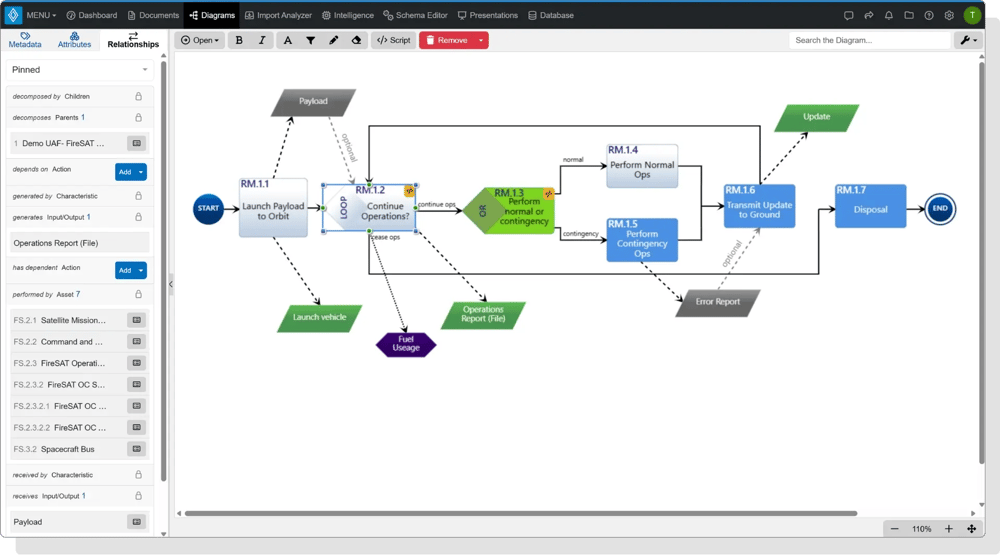
Organize requirements into structured system hierarchies while maintaining traceability across every level of decomposition.
Visualize complex engineering relationships through interactive graphs, such as spider diagrams, that make dependencies easier to understand.
Generate traceability matrices automatically rather than maintaining them manually.
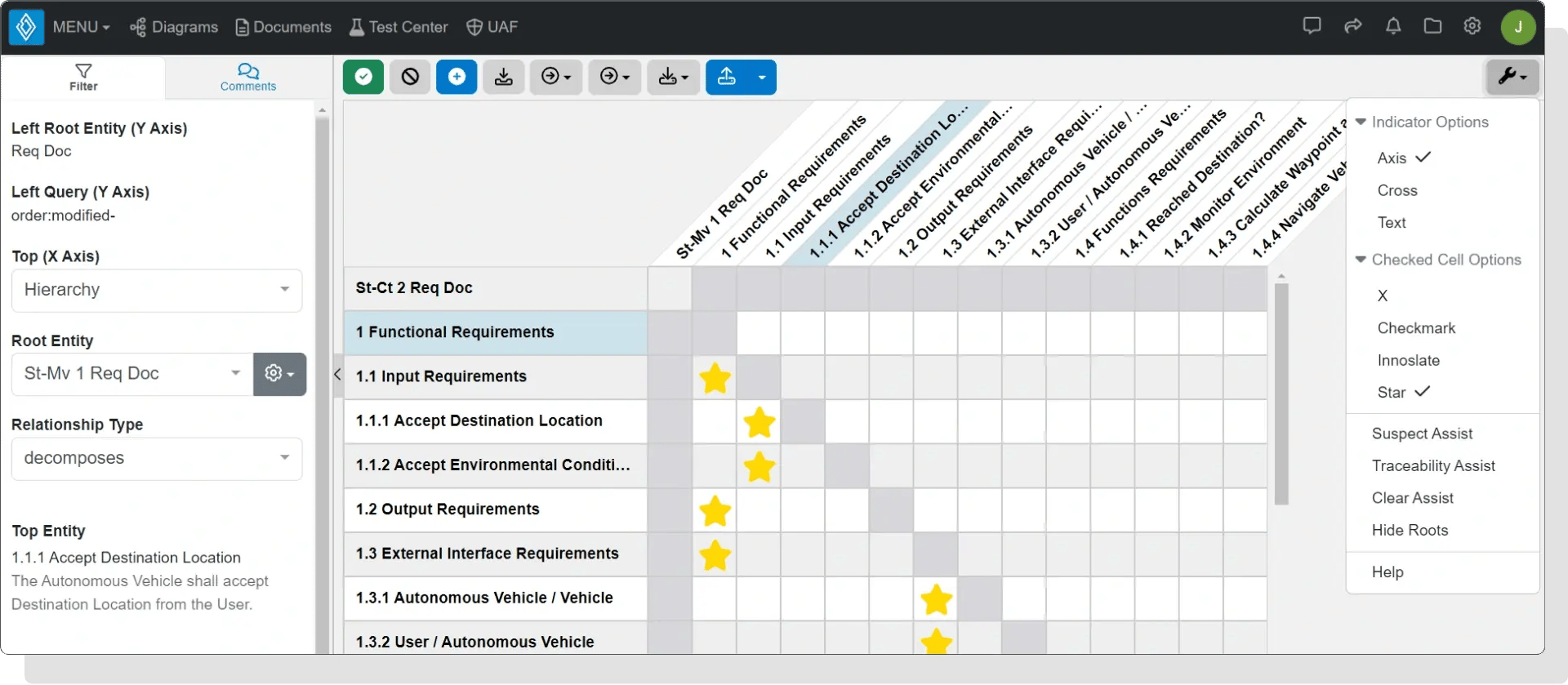
📖 Related Reading: How to Use a Requirements Traceability Matrix (RTM)
Instantly identify downstream effects of requirement changes by exploring connected relationships throughout the engineering model.
📖 Related Reading: Using Impact Analysis to Align Teams in MBSE
Maintain continuous connections between requirements, architecture, mission engineering, program management, verification, and risk management in one authoritative engineering knowledge base.
Artificial intelligence is most effective when it understands context. Rather than generating outputs from disconnected documents, Innoslate's AI features can leverage connected engineering relationships to assist with requirements generation, test development, document creation, and engineering analysis while preserving traceability throughout the lifecycle.

Organizations implementing traceability should:
Capture stakeholder needs before writing detailed requirements.
Maintain clear requirement hierarchies.
Connect requirements to architecture early in development.
Establish bidirectional relationships across engineering artifacts.
Link every requirement to verification activities.
Perform impact analysis before approving changes.
Review orphaned or unverified requirements regularly.
Use a centralized engineering platform instead of disconnected spreadsheets and documents.
End-to-end traceability is no longer just a documentation exercise or a compliance requirement. It is a fundamental capability for managing complex systems throughout their lifecycle.
When requirements, architecture, verification, risk, and program information remain connected, engineering teams can better understand change, improve collaboration, reduce rework, and make more informed decisions.
Rather than maintaining static traceability matrices, modern digital engineering platforms create a living digital thread that evolves alongside the system itself.
With Innoslate, organizations can connect stakeholder needs, requirements, architectures, verification activities, and program data in one collaborative environment, providing complete lifecycle traceability from concept through validation.
Create your free Innoslate Sandbox account to explore how requirements, architecture, verification, risks, and program data connect in a single cloud-native platform. Build your own digital thread, experiment with traceability features, and discover how connected engineering data can improve collaboration and decision-making.


SPEC Innovations Team : 9/11/26, 3:58 PM
Rather watch than read? Check out the recording!
SPEC Innovations Team : 7/28/26, 5:36 PM
Requirements are the foundation of every successful systems engineering project. When requirements are incomplete, ambiguous, or disconnected from...
.svg)
.svg) Steven Dam : 4/27/23, 2:43 PM
Steven Dam : 4/27/23, 2:43 PM
A Data Management Plan (DMP) is a crucial digital engineering tool for systems and digital engineers, serving as a visual framework that organizes...