Aerospace programs generate thousands of interconnected requirements spanning mission objectives, system architecture, hardware, software, interfaces, verification, safety, and regulatory obligations. Managing that complexity with spreadsheets, documents, and disconnected engineering applications can make it difficult to understand whether requirements are current, complete, compliant, and properly traced.
An aerospace requirements management system should do more than store requirements. It should connect requirements to the models, decisions, risks, tests, and other engineering data that define the system throughout its lifecycle.
For aerospace organizations evaluating requirements management software, the question is therefore not simply, “Can this tool manage requirements?” The better question is, “Can this platform help our engineering teams maintain an authoritative, traceable understanding of the system as it evolves?”
Here are the capabilities to prioritize.
1. End-to-end requirements traceability
Traceability is foundational to aerospace requirements management. When describing requirements management, NASA's Systems Engineering Handbook includes controlling and allocating requirements, managing baseline changes, and maintaining bidirectional traceability throughout the system lifecycle.
A strong platform should let engineers trace requirements in both directions; upward to their sources and downward to derived requirements, architecture, verification activities, and other system elements.
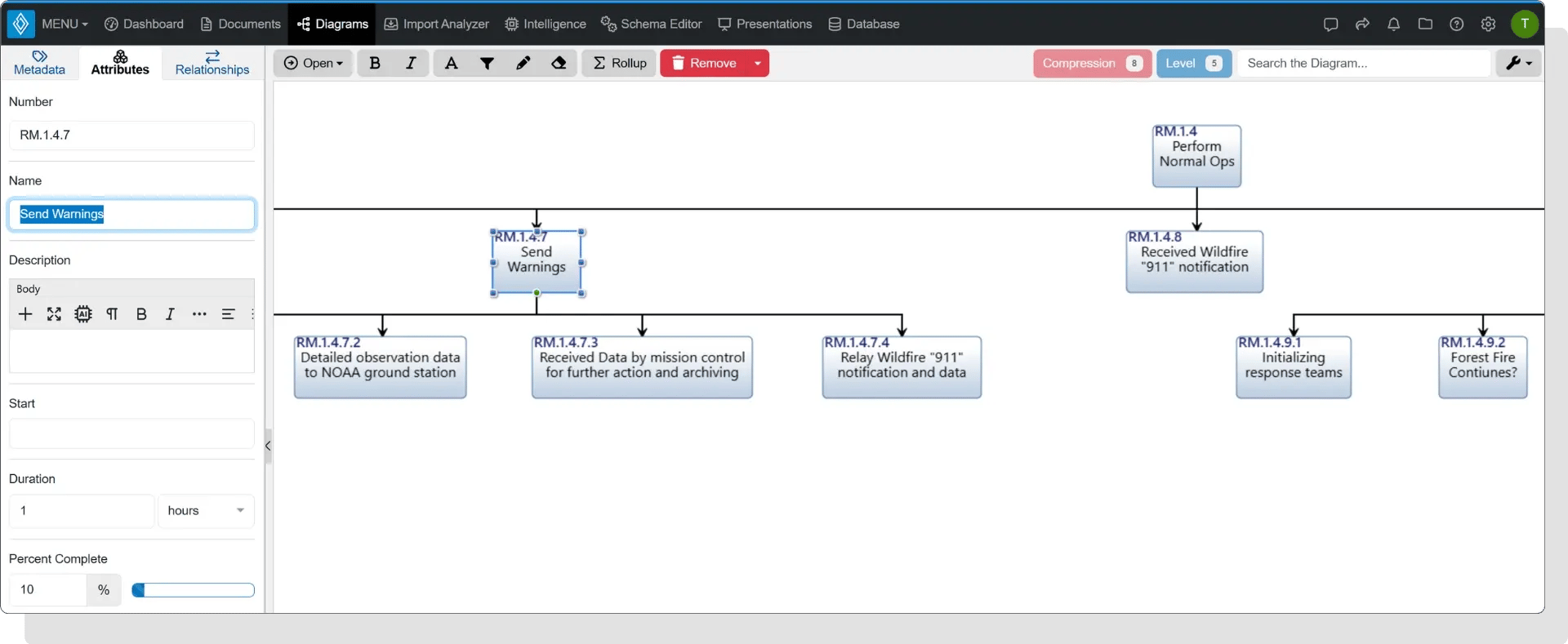
That means teams should be able to answer questions such as:
-
Where did this requirement originate?
-
Which subsystem or component satisfies it?
-
What other requirements depend on it?
-
How will it be verified?
-
What happens if it changes?
This becomes especially important as programs grow. Manually maintaining traceability matrices across spreadsheets and documents introduces opportunities for outdated links, missing relationships, and duplicated information.
An aerospace requirements management system should instead make traceability part of the underlying engineering data.
📡 Related Research: Agile vs. Waterfall for Satellites: An MBSE Simulation in Innoslate
2. Integrated MBSE and requirements management
Requirements do not exist independently of the system architecture. That is why aerospace organizations should evaluate whether a requirements tool also functions as model-based systems engineering (MBSE) software or integrates deeply with the team's MBSE environment.
NASA describes how system modeling can be integrated with systems engineering processes, including stakeholder expectation definition, technical requirements definition, product verification, and product validation.
Combining requirements and models helps teams connect what a system must do with how engineers intend to design, analyze, and verify it.
A capable digital engineering platform should allow engineers to move between requirements and architecture without recreating the same information in multiple applications. Ideally, diagrams, documents, simulations, and other views are generated from connected engineering data rather than maintained as independent artifacts.
3. A connected digital thread
Aerospace organizations increasingly need continuity of engineering information across disciplines and lifecycle phases.
The Digital Twin Consortium defines the digital thread as a bidirectional, dependable, and trustworthy interconnected information system that links multiple dimensions of a system, including its structure, behavior, time, and lifecycle stages. By connecting information across otherwise isolated data, repositories, and systems, a digital thread can improve visibility, interoperability, and informed decision-making throughout the engineering lifecycle.
When evaluating an aerospace requirements management system, look beyond whether individual features exist. Examine how information moves between them.
Can a requirement connect directly to architecture? Can architecture connect to behavior and simulation? Can verification results connect back to the requirement being evaluated? Can a change be understood across those relationships?
This connected approach reduces the need to reconcile separate versions of engineering information manually and gives teams a clearer view of how a proposed change could affect the broader system.
Innoslate, for example, combines requirements management, system and architecture modeling, verification and validation, product management, simulation, and documentation within one platform.
📖 Related Reading: Building a Digital Thread
4. Compliance and verification support
Compliance in aerospace and defense is not something teams can bolt onto a program shortly before a review.
Requirements need clear sources, relationships, baselines, verification methods, and supporting evidence. NASA's Systems Engineering Handbook recommends identifying a verification approach while requirements are being developed and connecting requirements with their sources and verification information.
Your aerospace requirements software should therefore support:
-
Requirement baselines and change history
-
Verification methods and test cases
-
Links between requirements and verification results
-
Compliance and traceability matrices
-
Formal reviews and approvals
-
Controlled documentation
-
Impact analysis when requirements change
For teams working in regulated or government environments, security, deployment, permissions, and organizational compliance requirements should also be part of the buying decision; not an afterthought.
📖 Related Reading: Navigating Defense and Aerospace Compliance With MBSE
5. Configuration and change management
Aerospace systems can have long development and operational lifecycles. Requirements will change as designs mature, testing uncovers new information, interfaces evolve, and stakeholders refine their needs.
NASA specifically identifies managing changes to established requirement baselines as a core requirements management activity. Your platform should make those changes controlled and visible.
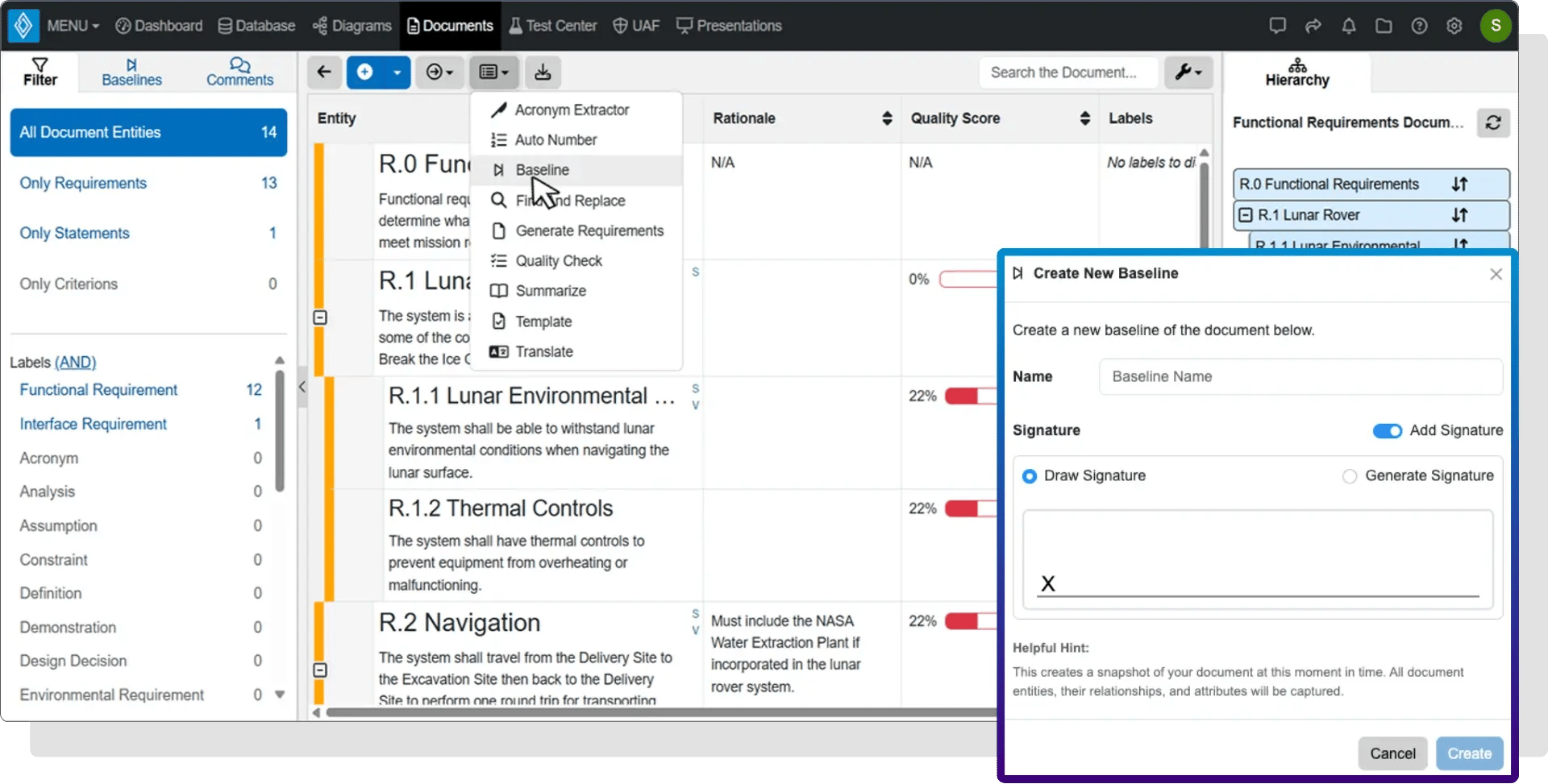
Look for features such as baselining, version history, change requests, approval workflows, permissions, and impact analysis. Engineers should be able to understand not only what changed, but also why it changed and what else the change affects.
This is one of the most important distinctions between dedicated engineering lifecycle management capabilities and a collection of static documents.
6. AI that supports engineering judgment
AI is becoming increasingly useful for requirements engineering, but aerospace teams should evaluate it based on practical engineering outcomes rather than novelty. Useful applications can include detecting poorly written requirements, identifying potential modeling issues, assisting with traceability, and accelerating the creation or review of requirements.
Innoslate, for example, provides AI-powered requirements quality checking and generation capabilities, while its digital engineering features use natural language processing to support requirements quality, model analysis, and traceability.
AI should assist engineers rather than obscure engineering decisions. For high-consequence systems, teams still need clear data provenance, human review, configuration control, and traceability.
When comparing platforms, ask vendors to demonstrate where AI-generated or AI-assisted information enters the engineering process and how engineers can validate it.
📄 Whitepaper: Human vs. AI Process
7. Real-time collaboration without losing control
Modern aerospace programs are rarely built by one engineering team in one location. Government organizations, primes, subcontractors, suppliers, universities, and specialists may all contribute to the system. That makes collaboration a core requirement.
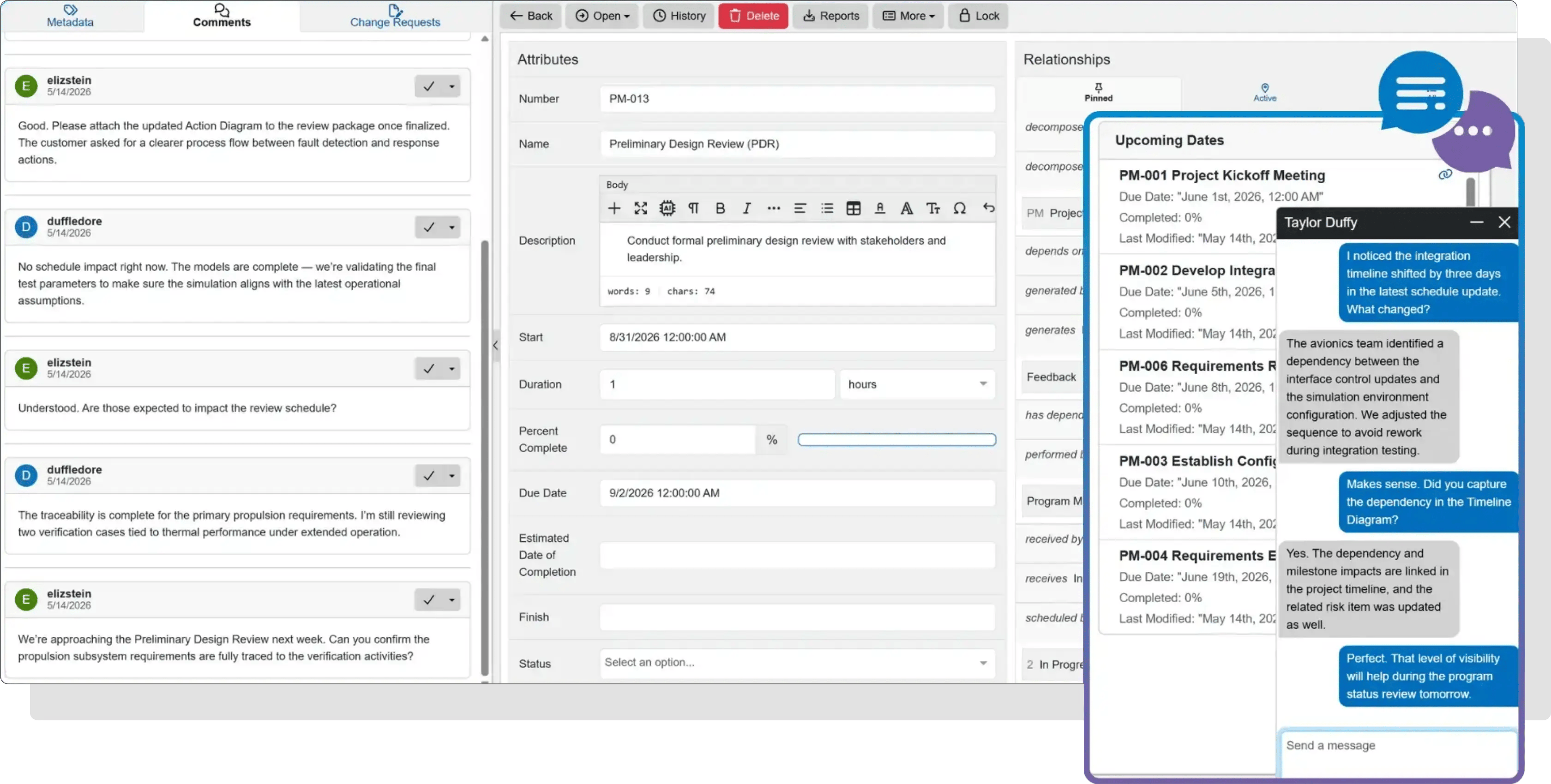
Look for an aerospace requirements management system that supports real-time collaboration while maintaining appropriate permissions and configuration control. Engineers should be able to work from the same engineering data rather than emailing spreadsheets or manually merging document revisions.
Cloud-native platforms can be especially useful for distributed teams when the deployment model meets the organization's security requirements.
Innoslate, for instance, provides a cloud-native environment designed for real-time collaboration, with requirements, architecture, verification, and other lifecycle information maintained in a connected platform.
8. Integration and data portability
Even a comprehensive platform will exist within a larger engineering toolchain. Your requirements platform should therefore support moving and integrating engineering information without forcing teams into fragile manual processes.
Evaluate available APIs, supported import/export formats, and interoperability with existing engineering applications. Innoslate supports REST and Java APIs along with data exchange mechanisms including XML, XMI, Word, CSV, and plain-text imports.
The goal is not necessarily to force every discipline into one application. It is to establish an engineering environment in which important information can remain connected and usable across the lifecycle.
📑 Guide: Innoslate Integration Overview
A practical aerospace requirements management system checklist
Before choosing a platform, ask:
-
Traceability: Can we maintain bidirectional traceability from stakeholder needs through requirements, architecture, and verification?
-
MBSE: Can requirements connect directly to system models and architecture?
-
Digital thread: Can teams understand relationships and impacts across lifecycle data?
-
Compliance: Can we maintain baselines, evidence, approvals, and verification records?
-
Change management: Can engineers quickly understand the impact of a requirement change?
-
AI: Does AI improve requirement quality and engineering productivity while keeping engineers in control?
-
Collaboration: Can distributed teams work simultaneously without creating competing sources of truth?
-
Security: Does the deployment approach satisfy organizational and program requirements?
-
Integration: Can the platform exchange information with the rest of the engineering ecosystem?
-
Lifecycle coverage: Can the platform grow beyond requirements management as the program moves into architecture, analysis, verification, and operations?
From requirements management to digital engineering
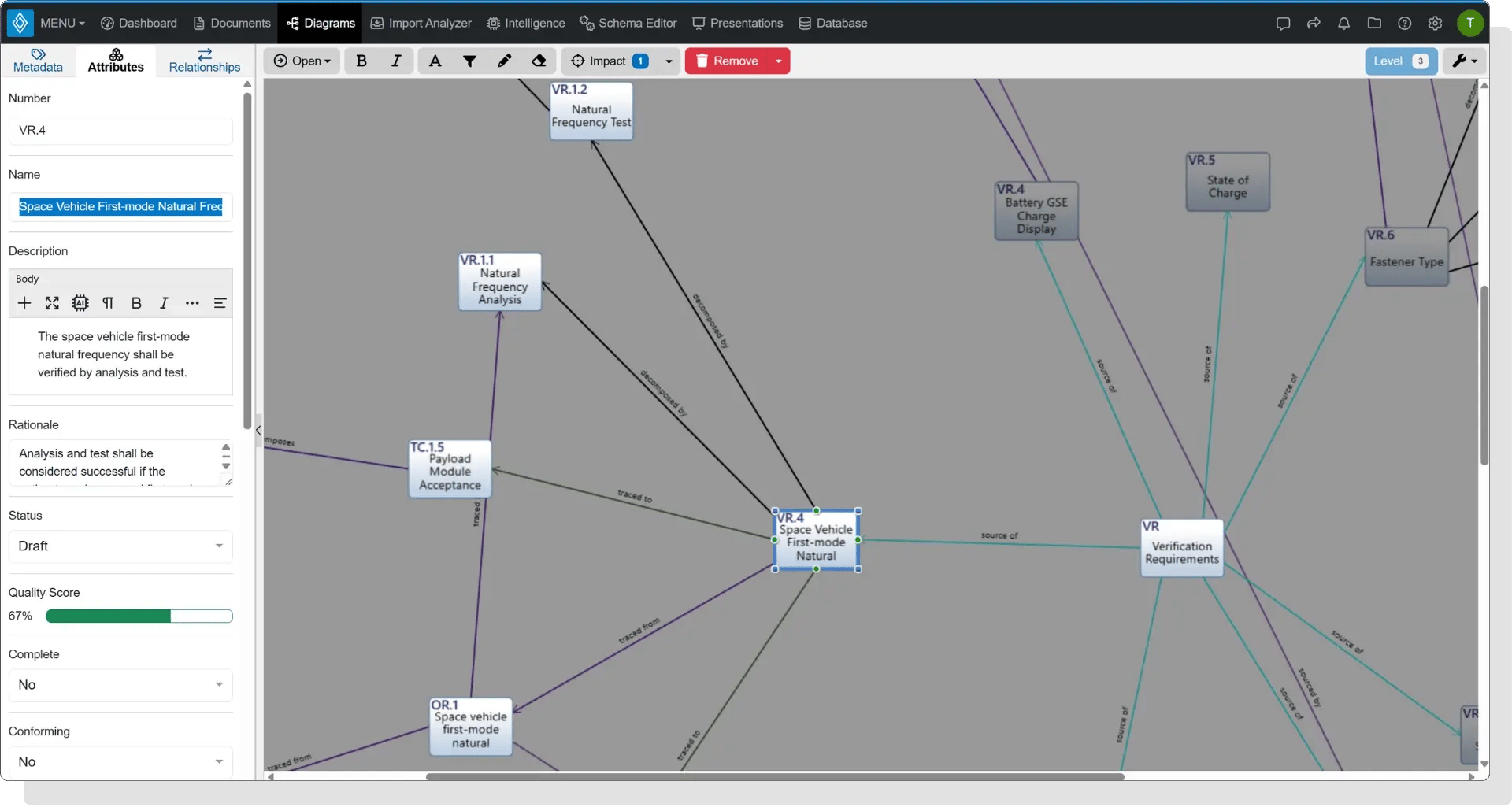
The best aerospace requirements management system is not simply the application with the longest feature list. It is the one that helps engineers maintain trustworthy relationships between requirements and the rest of the system.
For organizations moving toward MBSE and digital engineering, that distinction matters. Requirements, models, tests, risks, decisions, and documents increasingly need to function as connected parts of the same engineering lifecycle rather than isolated artifacts.
Innoslate was built around that connected approach, combining requirements management and MBSE with architecture modeling, simulation, verification and validation, documentation, and collaboration.
Compare Innoslate with traditional requirements tools.
Start your Free Forever Innoslate Sandbox or schedule a demo to see how a connected digital engineering platform can support your aerospace program.

.svg) SPEC Innovations Team
SPEC Innovations Team



.svg) Steven Dam : 8/7/24, 2:20 PM
Steven Dam : 8/7/24, 2:20 PM
.svg)