Requirements management has always required a careful balance of communication, analysis, documentation, traceability, and verification. As systems become more complex and engineering teams manage increasingly large amounts of interconnected data, maintaining that balance can become difficult.
Artificial intelligence is beginning to change that.
AI requirements management uses artificial intelligence to support activities throughout the requirements lifecycle, from gathering and drafting requirements to checking their quality, analyzing changes, maintaining traceability, and preparing for verification.
The goal isn't to replace the systems engineer. Instead, AI can reduce repetitive work, surface information faster, and give engineers more time to focus on the decisions that require technical expertise and human judgment.
How is AI changing requirements management?
Traditional requirements management can involve a significant amount of manual work. Engineers may spend hours reviewing documents, rewriting requirement statements, updating a requirements traceability matrix, comparing revisions, or identifying which parts of a system could be affected by a change.
AI introduces another layer of assistance to requirements management tools and software. Rather than simply storing and organizing requirements, AI-enabled tools like Innoslate can help engineers interpret, generate, review, and analyze engineering information.
Innoslate's AI capabilities can support several parts of the process:
-
Gathering and organizing requirements
-
Drafting and refining requirement statements
-
Checking requirement quality
-
Identifying missing or inconsistent information
-
Supporting traceability
-
Analyzing the potential impact of changes
-
Generating verification and test cases
-
Summarizing large amounts of engineering information
These capabilities can be especially useful for large programs where hundreds or thousands of requirements must remain connected to stakeholder needs, architecture, risks, tests, and other engineering artifacts.
.webp?width=910&height=474&name=Innoslate%20AI%20Requirements%20Generation%20and%20Expansion%20(1).webp)
1. AI can accelerate requirements gathering
Requirements gathering often begins with large amounts of unstructured information: stakeholder interviews, operational documents, meeting notes, regulations, existing specifications, and other source material.
AI tools in Innoslate can help engineers turn that information into a more structured starting point.
For example, an engineer could provide our AI assistant with a system description and ask it to identify potential stakeholder needs, constraints, functional requirements, or areas requiring clarification.
This can accelerate early requirements development, but the results still need engineering review. AI does not inherently know whether a generated requirement accurately reflects stakeholder intent, is technically feasible, or is appropriate for the system.
Think of the output as a starting point rather than an approved baseline.
📑 Guide: AI in MBSE: Use Cases
2. AI can help draft and refine requirements
Writing good requirements takes practice. Requirements should communicate the intended capability clearly enough that designers understand what must be built and verification teams understand what must be demonstrated.
INCOSE's Requirements Working Group develops guidance for needs and requirements definition and management, including its Guide to Writing Requirements. AI can help apply these kinds of established practices during the writing process.
For example, Innoslate's AI quality checker can flag potential ambiguity, vague terminology, overly complex statements, or requirements that may be difficult to verify. AI can also suggest revised language.
Instead of manually reviewing every statement for the same common problems, engineers can use AI to perform an initial quality review before conducting the formal human review.
.webp?width=1920&height=1068&name=Innoslate%20Quality%20Checker%20(1).webp)
📽️ Webinar: Meet INCOSE's Guide to Writing Requirements With AI Quality Checker
3. AI can identify gaps and inconsistencies
Requirements rarely exist independently. They form a connected set that must collectively describe the system. That creates another opportunity for AI: reviewing information across a larger requirements set.
AI in Innoslate can help engineers look for:
-
Duplicate or overlapping requirements
-
Potential contradictions
-
Missing information
-
Inconsistent terminology
-
Requirements without sufficient context
-
Areas that may need additional decomposition
This doesn't mean AI can determine whether a requirements baseline is complete on its own. Completeness depends heavily on mission objectives, stakeholder expectations, system context, regulations, and engineering judgment.
However, AI can act as another review mechanism, helping engineers identify areas worth investigating.
📄 Whitepaper: Human vs. AI Process
4. AI can support requirements traceability
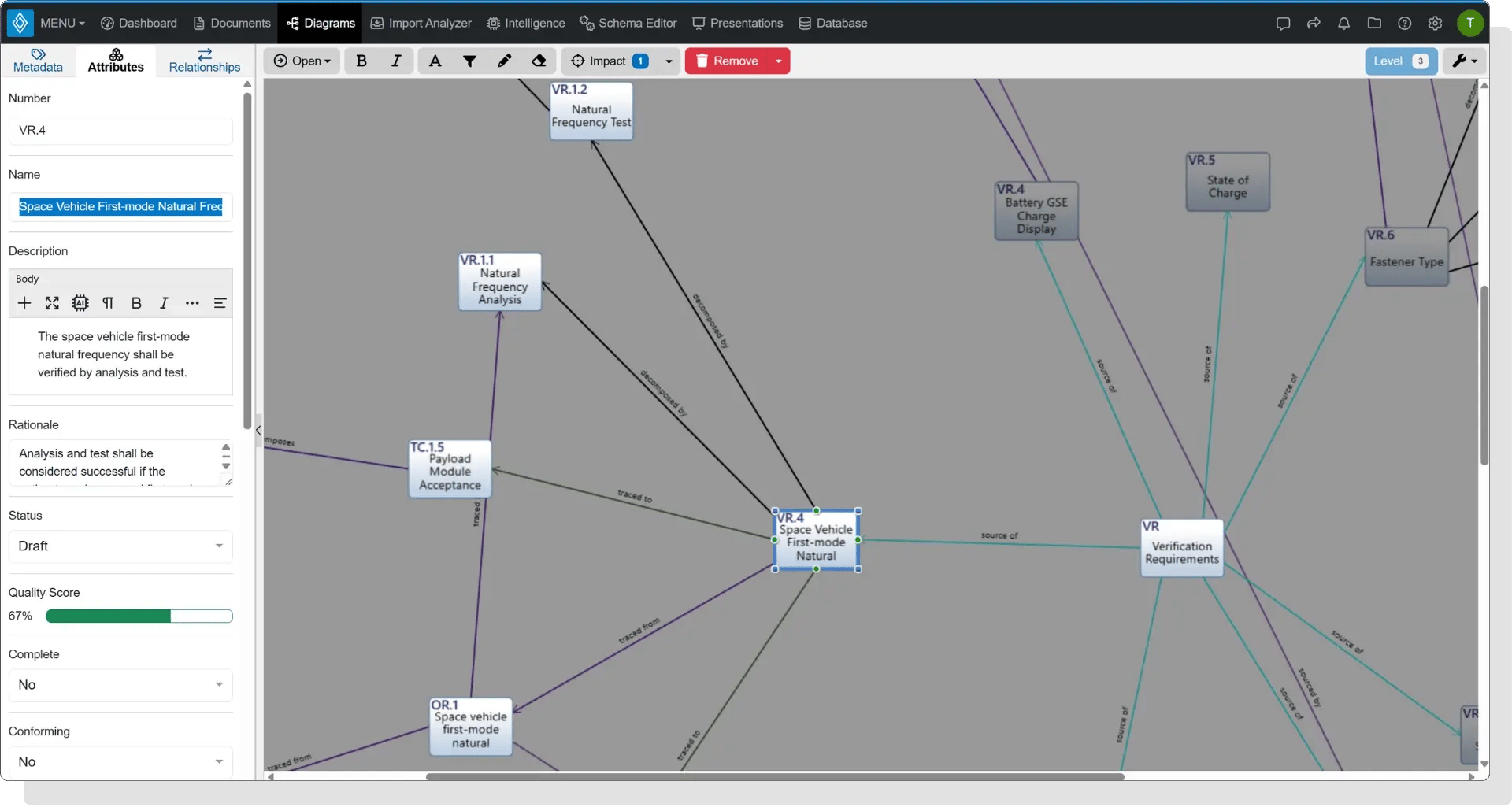
Maintaining traceability becomes increasingly difficult as a project grows. A requirement may be connected to stakeholder needs, other requirements, architecture elements, interfaces, risks, verification methods, test cases, and more.
When one item changes, engineers need to understand what else could be affected. End-to-end traceability creates these relationships across the engineering lifecycle.
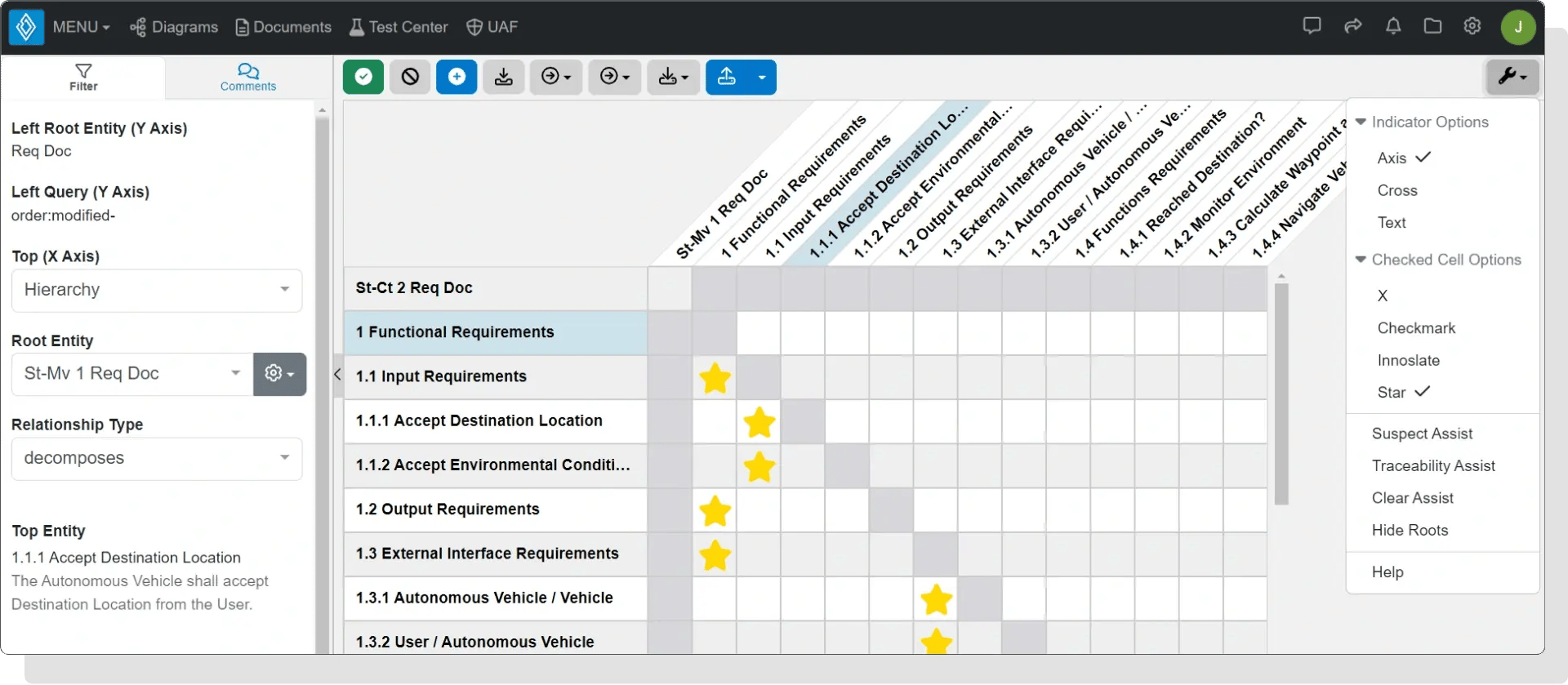
AI can make connected engineering data easier to explore. Instead of manually navigating every relationship or maintaining a static requirements traceability matrix, engineers can use AI-assisted analysis to investigate relationships and identify relevant information more quickly.
This is particularly powerful when AI operates within a connected engineering environment like Innoslate rather than across isolated documents.
5. AI can improve change and impact analysis
Requirements change. The challenge is determining what that change means for everything else.
Imagine that a performance requirement changes midway through development. That update could affect subsystem requirements, architecture, interfaces, risks, simulation parameters, test procedures, cost, or schedule.
Innoslate's AI-assisted impact analysis can help engineers investigate those relationships and surface potentially affected artifacts.
The engineer still determines whether an identified relationship represents a meaningful impact, but AI can reduce the amount of information that must be manually searched before making that decision.
This can support traditional development as well as agile requirements management, where teams may evaluate and incorporate changes more frequently.
6. AI can help generate verification and test cases
Requirements management doesn't stop once a requirement has been written. Teams also need to determine how each requirement will be verified.
AI can help turn requirements information into an initial set of verification activities or structured test cases.
Innoslate's AI assistant might suggest a verification method, test procedure, expected result, or potential edge case. Engineers can then review those suggestions and refine them according to the actual system, verification environment, and program constraints.
Connecting requirements and verification early also makes it easier to maintain traceability as the design evolves.
📖 Related Reading: AI Tools to Support Requirements Engineering & Test Case Developments
AI doesn't replace the requirements management process
Adding AI doesn't eliminate the need for a defined process or a requirements management plan.
Whether an organization uses a requirements management plan template, an existing requirements management plan example, or its own established process, teams still need to define responsibilities, approval workflows, baselines, change control, traceability expectations, and verification practices.
Human oversight becomes even more important when AI enters the workflow.
NIST's AI Risk Management Framework provides voluntary guidance for managing AI risk and incorporating trustworthiness considerations into the design, development, use, and evaluation of AI systems. NIST organizes its AI risk management approach around four functions: Govern, Map, Measure, and Manage.
For engineering organizations, practical AI governance can include:
-
Reviewing AI-generated content before approval
-
Validating outputs against authoritative source information
-
Maintaining traceability to original engineering data
-
Documenting assumptions
-
Controlling what project information can be provided to AI systems
-
Establishing clear responsibility for final engineering decisions
AI should support the engineering authority, not become the engineering authority.
The future of AI requirements management
The biggest change may not be AI generating individual requirements. It may be AI helping engineers work with the entire connected body of engineering information surrounding those requirements.
When requirements are connected to architecture, verification, risk, modeling, simulation, and program information, AI can provide assistance with far more context than it could from an isolated document.
Innoslate brings requirements management, MBSE, digital engineering, verification, risk, simulation, and other engineering activities into a connected environment. Innoslate's AI capabilities can support activities such as requirements generation, quality analysis, test development, summarization, and other engineering workflows while engineers remain responsible for reviewing and approving the results.
AI isn't eliminating the requirements management process. It's giving engineering teams new ways to move through that process more efficiently while keeping human expertise at the center.
See how Innoslate applies AI to requirements and engineering workflows.
Create your Free Forever Sandbox and start exploring Innoslate.


.svg) SPEC Innovations Team : 10/6/26, 3:46 PM
SPEC Innovations Team : 10/6/26, 3:46 PM