How to Build End-to-End Traceability
.svg) Steven Dam : 7/20/26, 1:45 PM
Steven Dam : 7/20/26, 1:45 PM
Modern engineering projects generate thousands of interconnected pieces of information. Stakeholder needs evolve, requirements change, architectures...

Successful software projects begin with clear, well-defined requirements. Before development starts, teams need a shared understanding of what they're building, why they're building it, and how success will be measured. That's where a software requirements gathering template becomes invaluable.
Rather than collecting information in scattered documents, spreadsheets, or emails, a standardized template helps teams capture requirements consistently and establishes a strong foundation for requirements management. By organizing requirements from the beginning, teams can improve collaboration, maintain traceability, and manage changes throughout the engineering lifecycle.
In this blog, you'll learn what a software requirements gathering template should include, how to build one, and how Innoslate helps teams create reusable templates while maintaining end-to-end traceability throughout the engineering lifecycle.
A software requirements gathering template is a standardized framework used to document the information needed before software design and development begin. It also serves as the foundation for effective requirements management, providing a structured way to capture, organize, review, and maintain software requirements throughout a project's lifecycle.
According to the IEEE Computer Society's Software Engineering Body of Knowledge (SWEBOK), software requirements engineering includes requirements elicitation, analysis, specification, and validation. A well-designed software requirements gathering template helps organize these activities by providing a consistent structure for documenting stakeholder needs before development begins.
Instead of creating a new requirements document for every project, organizations use templates to capture consistent information such as:
Business objectives
Stakeholder needs
Functional requirements
Nonfunctional requirements
Constraints and assumptions
Acceptance criteria
Verification methods
Using a template improves consistency across projects while making requirements easier to review, update, and reuse.
📖 Related Reading: 9 Methods for Requirements Gathering
A good template does more than organize information; it improves the overall quality of your requirements. Benefits include:
✅ Consistency: Every project follows the same proven structure.
✅ Improved collaboration: Stakeholders, engineers, and project managers work from a shared source of information.
✅ Fewer missed requirements: Standard sections reduce the chance of overlooking important details.
✅ Better traceability: Requirements can be linked to stakeholder needs, architecture, design decisions, and verification activities.
✅ Faster project startup: Teams spend less time creating documentation from scratch.
✅ Supports requirements management: A standardized template creates a consistent starting point for requirements management by organizing requirements, tracking ownership, documenting changes, and maintaining traceability as projects evolve.
As projects become more complex, having a repeatable process for gathering software requirements becomes increasingly important.
While every organization has unique processes, most software requirements templates should capture the following information.
Begin with a brief description of the project's purpose, scope, and business objectives. This provides context for everyone involved in development.
Identify the people or groups providing requirements, including customers, product owners, end users, developers, security teams, and regulatory stakeholders.
Recording the source of each requirement also supports future traceability.
Functional requirements describe what the software must do.

Each requirement should be specific, measurable, and testable.
Nonfunctional requirements describe how well the system performs.
Examples include performance, security, reliability, scalability, availability, and accessibility.
These requirements are just as important as functional capabilities and should be captured early in the project.
📖 Related Reading: Non-Functional vs. Functional Requirements
Acceptance criteria define how a requirement will be verified.
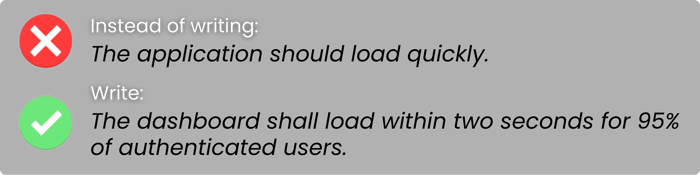
Measurable acceptance criteria eliminate ambiguity during testing.
Creating an effective template doesn't have to be complicated. Focus on building a repeatable process that your organization can use across multiple projects.
Start by documenting the business objectives. Ask questions like:
.webp?width=600&height=140&name=Questions%20that%20Define%20project%20goals%20(1).webp)
These goals provide context for every requirement that follows.
Requirements come from many sources, including customers, users, developers, operations teams, and subject matter experts. Capturing each requirement alongside its stakeholder source improves accountability and makes future reviews much easier.
📖 Related Reading: 9 Ways to Align Requirements With Stakeholder Needs
Rather than creating one long list, organize requirements into logical categories such as user management, security, reporting, notifications, integrations, and performance.
This structure keeps requirements manageable and supports effective requirements management by making it easier to review, prioritize, and update requirements as the project progresses.
Good requirements are specific and verifiable.
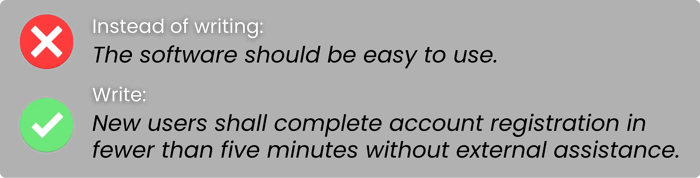
Avoid subjective language like easy, fast, or user-friendly unless those terms are supported by measurable criteria.
📖 Related Reading: How to Write Good Requirements: 10 Tips and Examples
Planning verification during requirements gathering helps ensure every requirement can eventually be validated. Common verification methods include inspection, analysis, demonstration, and test.
Including this information early reduces confusion later in the development process.
📖 Related Reading: Plan Verification & Validation Early in the Lifecycle
A simple template might include the following fields:
| Field | Example |
| Requirement ID | SW-001 |
| Title | User Authentication |
| Description | The application shall authenticate users using Single Sign-On (SSO). |
| Priority | High |
| Stakeholder | IT Security |
| Acceptance Criteria | Users successfully authenticate through Azure AD. |
| Verification Method | Functional Test |
As projects become more complex, additional fields such as risk, status, version, or related requirements can be added without changing the overall structure.
While Word documents and spreadsheets can capture software requirements, maintaining them becomes increasingly difficult as projects evolve.
Innoslate's comprehensive requirements management allows teams to capture requirements, organize them into structured hierarchies, manage changes, and maintain traceability throughout the engineering lifecycle.
By combining structured requirements management with model-based systems engineering (MBSE), Innoslate supports the same lifecycle described in SWEBOK, from requirements elicitation and specification to validation and ongoing change management, while maintaining complete end-to-end traceability.
📖 Related Reading: How MBSE and Requirements Management Work Together
Organizations can create a standardized template project containing predefined requirement categories, metadata, approval workflows, and verification methods.
Rather than starting from scratch, new software projects can begin from this reusable foundation.

Instead of relying on document headings, Innoslate stores requirements as structured entities that can be organized into hierarchies and categorized by function, subsystem, or feature. This makes requirements easier to search, filter, and manage throughout development.
SEBoK emphasizes that requirements should not remain isolated documents. Instead, they should be connected to architecture, design, verification, and other engineering artifacts while maintaining bidirectional traceability across the lifecycle. Innoslate supports this model by allowing teams to link software requirements directly to stakeholder needs, system architecture, test cases, risks, and verification activities within a single digital engineering environment.
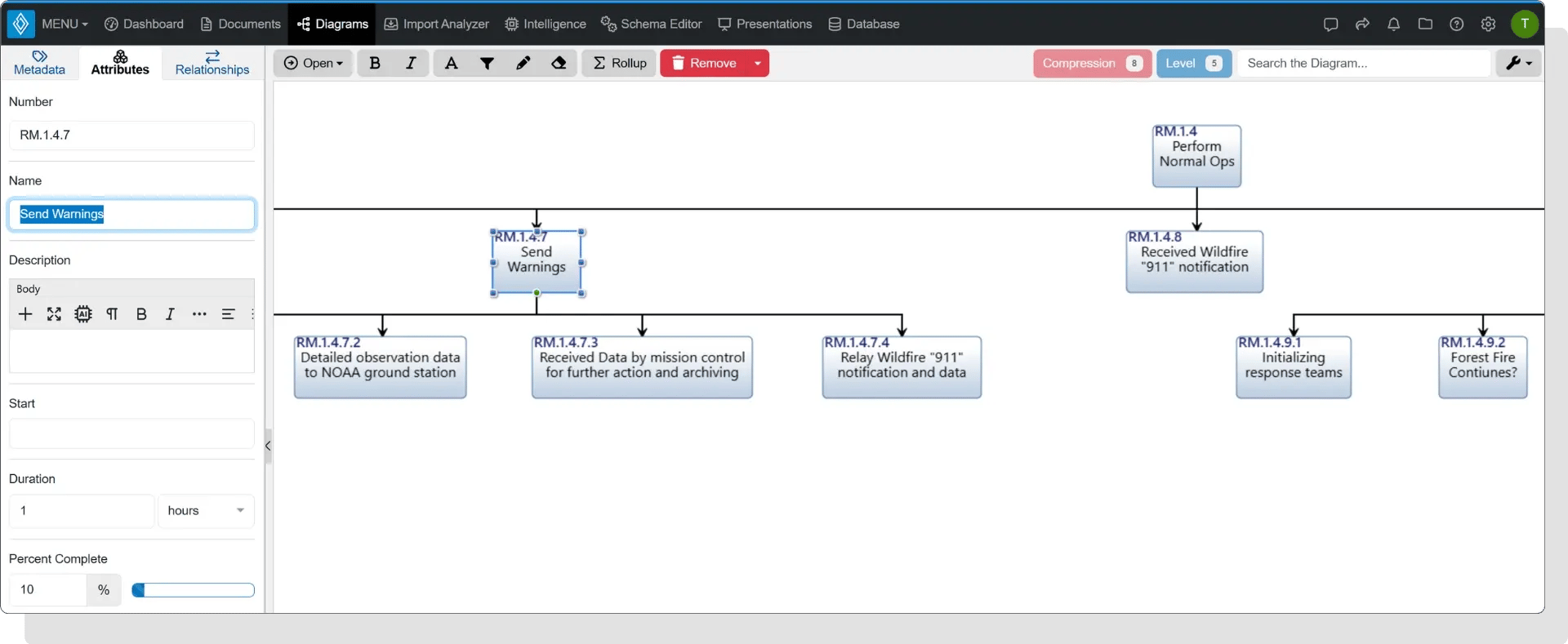
One of Innoslate's biggest advantages for requirements management is maintaining relationships between software requirements and other engineering artifacts.
Software requirements can be linked directly to stakeholder needs, system architecture, test cases, risks, verification activities, design decisions, and more.
If a requirement changes, teams can immediately identify the downstream artifacts that may be affected, making change management significantly easier.
📖 Related Reading: How to Build End-to-End Traceability
Once requirements have been captured, Innoslate can generate reports directly from the project. Instead of manually updating Word documents, teams can create consistent documentation using the latest project data.
.webp?width=1920&height=1077&name=Innoslate%20Report%20Generation%20(1).webp)
Innoslate's AI capabilities can help generate initial requirement statements, summarize existing documentation, and improve requirement wording.
AI assists with repetitive documentation tasks while engineers remain responsible for reviewing and approving the final requirements.
📖 Related Reading: AI Tools for Requirements Gathering
Whether you're creating your first template or improving an existing one, these best practices can help produce higher-quality requirements:
Involve stakeholders early.
Write clear, measurable requirements.
Separate requirements from implementation decisions.
Include acceptance criteria.
Plan verification from the beginning.
Maintain traceability across the engineering lifecycle.
Reuse standardized templates whenever possible.
Following a consistent process helps reduce ambiguity and improves collaboration across engineering teams.
A software requirements gathering template is the first step toward successful requirements management. By standardizing how requirements are gathered, organizations can improve collaboration, reduce rework, and establish a repeatable process for managing requirements throughout the software development lifecycle.
With Innoslate, software requirements gathering becomes part of a complete requirements management solution. Teams can capture stakeholder needs, organize requirements, maintain end-to-end traceability, manage changes, and generate documentation from a single connected digital engineering environment.
Create a Free Forever Innoslate Sandbox and start building reusable requirements templates with complete end-to-end traceability today.

Continue Learning:
Steven Dam : 7/20/26, 1:45 PM
Modern engineering projects generate thousands of interconnected pieces of information. Stakeholder needs evolve, requirements change, architectures...

.svg) SPEC Innovations Team : 9/17/26, 9:13 AM
SPEC Innovations Team : 9/17/26, 9:13 AM
Successful requirements gathering depends on more than documenting what a system needs to do. It depends on getting the right people involved,...

SPEC Innovations Team : 8/11/26, 3:00 PM
Aerospace requirements management involves more than documenting what an aircraft, spacecraft, or supporting system must do. Aerospace programs bring...