When every stakeholder believes their requirement is the most important, deciding what comes first can quickly become one of the hardest parts of a project.
Effective requirements prioritization is a critical part of requirements management. It’s more than ranking a list from high to low. Teams have to weigh business value, technical risk, dependencies, urgency, compliance, cost, and stakeholder needs, all while maintaining alignment on what the system is actually supposed to accomplish.
Without a structured process, prioritization can become subjective. The loudest stakeholder wins, everything gets labeled “high priority,” or teams make decisions without understanding their downstream effects.
A better approach combines clear criteria, stakeholder participation, requirements analysis best practices, and traceability. Here’s how to prioritize competing requirements without losing stakeholder alignment along the way.
Why requirements prioritization matters
Not all requirements carry equal value, risk, or urgency. PMI identifies factors such as business value, business or technical risk, implementation difficulty, regulatory or policy compliance, dependencies, stakeholder agreement, and urgency as considerations when prioritizing requirements.
Prioritization forces teams to make those tradeoffs explicit. It helps answer questions such as:
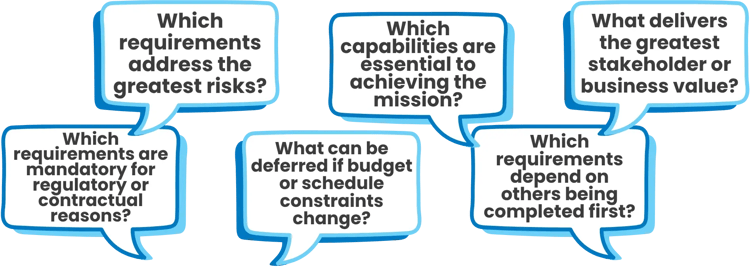
Good prioritization also supports better requirements quality because it requires teams to understand each requirement well enough to evaluate its value and impact.
If a requirement is ambiguous, disconnected from a stakeholder need, or impossible to verify, assigning it a meaningful priority becomes much harder.
In a strong requirements management process, prioritization helps teams determine which requirements deserve attention first while preserving the context behind those decisions.
📖 Related Reading: The Cost of Bad Requirements
Start with stakeholder needs, not individual requests
Before ranking requirements, establish what stakeholders actually need the system to accomplish.
Stakeholder requests and stakeholder needs are not always the same thing. A stakeholder may request a specific feature or implementation, but the underlying need may be achievable in several ways.
SEBoK distinguishes stakeholder needs from the more formal requirements that are developed from them. Stakeholder needs focus on the desired capabilities and outcomes from the stakeholder perspective, while system requirements translate those needs into technical statements describing what the system must do.
That distinction is important during prioritization.
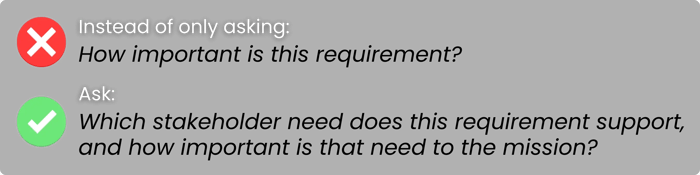
Maintaining those relationships gives the team context when competing requirements emerge.
This is also why early requirements gathering and stakeholder analysis matter. Identifying stakeholders, understanding their objectives, and capturing the rationale behind their needs creates a stronger foundation for later prioritization.
📖 Related Reading: How to Write Agile Stories for Requirements Gathering
Define prioritization criteria before ranking requirements
One of the most common poor requirements analysis practices is assigning priorities without first agreeing on what “priority” means.
Different stakeholders naturally evaluate requirements through different lenses. A program manager may prioritize schedule. An engineer may focus on technical risk. A customer may emphasize capability. A compliance team may consider a requirement non-negotiable.
Establishing criteria before discussing individual requirements makes the process more objective. Common criteria include:
-
Mission or business value: How strongly does the requirement contribute to the primary objective?
-
Stakeholder value: How important is the capability to affected stakeholders?
-
Risk: What happens if the requirement is delayed or omitted?
-
Compliance: Is the requirement required by a law, regulation, contract, or standard?
-
Dependencies: Do other requirements or system elements depend on it?
-
Cost and effort: What resources are necessary to implement it?
-
Technical feasibility: Can it realistically be implemented within existing constraints?
-
Urgency: Does the requirement need to be delivered within a specific timeframe?
-
Verification: Can the team objectively demonstrate that the requirement has been satisfied?
Agreeing on these criteria makes later tradeoff conversations much easier to explain and defend.
📖 Related Reading: Stakeholder Roles in Requirements Management
Choose a requirements prioritization method
There is no single prioritization technique that works for every project. The right method depends on project complexity, the number of requirements, and the decisions the team needs to make.
MoSCoW prioritization 🔝
MoSCoW divides requirements into four categories:
-
Must have: Essential for project or system success.
-
Should have: Important, but the project can still succeed temporarily without them.
-
Could have: Valuable additions that can be deferred if necessary.
-
Won’t have: Explicitly excluded from the current scope or release.
MoSCoW is easy for stakeholders to understand and works well when teams need to establish scope quickly.
The challenge is preventing every requirement from becoming a “Must.” Define clear qualification criteria before the requirements review begins.
Weighted scoring 💯
For complex projects, weighted scoring provides more granularity. Teams establish evaluation criteria, such as stakeholder value, risk, cost, urgency, and compliance, and assign each criterion a weight.
Requirements are then scored against those factors. The resulting scores provide a consistent starting point for comparison.
Weighted scoring does not replace engineering judgment, but it makes the reasoning behind decisions much more visible.
Value vs. effort 🏋️
A value vs. effort matrix compares the expected value of a requirement against the effort necessary to implement it.
High-value, low-effort requirements become obvious candidates for early attention, while low-value, high-effort requirements deserve additional scrutiny.
This method can be especially useful for product managers and Agile teams working with constrained development capacity.
Risk-based prioritization ⚠️
For safety-critical, regulated, or technically complex systems, risk may deserve greater weight.
Requirements associated with high-consequence hazards, critical interfaces, major technical uncertainty, or compliance obligations may need to take precedence even when they do not provide the highest visible user value.
The important point is consistency: choose a method that reflects the project's objectives and constraints, and document why it was selected.
Maintain traceability during prioritization
Traceability is one of the reasons effective requirements management matters during prioritization. When requirements remain connected to stakeholder needs, risks, dependencies, architecture, and verification activities, teams can evaluate the broader impact of changing a priority.
SEBoK describes requirements management as including communication, baselining, change management, and bidirectional traceability between needs, requirements, and other systems engineering artifacts.
Traceability lets teams answer a much more useful question than, “Which requirement is ranked higher?” They can ask, "What else is affected if we move, modify, or remove this requirement?"
For example, lowering the priority of one requirement may affect several dependent requirements, an architecture decision, a test case, or a stakeholder objective. That context helps stakeholders understand tradeoffs instead of seeing prioritization decisions as arbitrary.
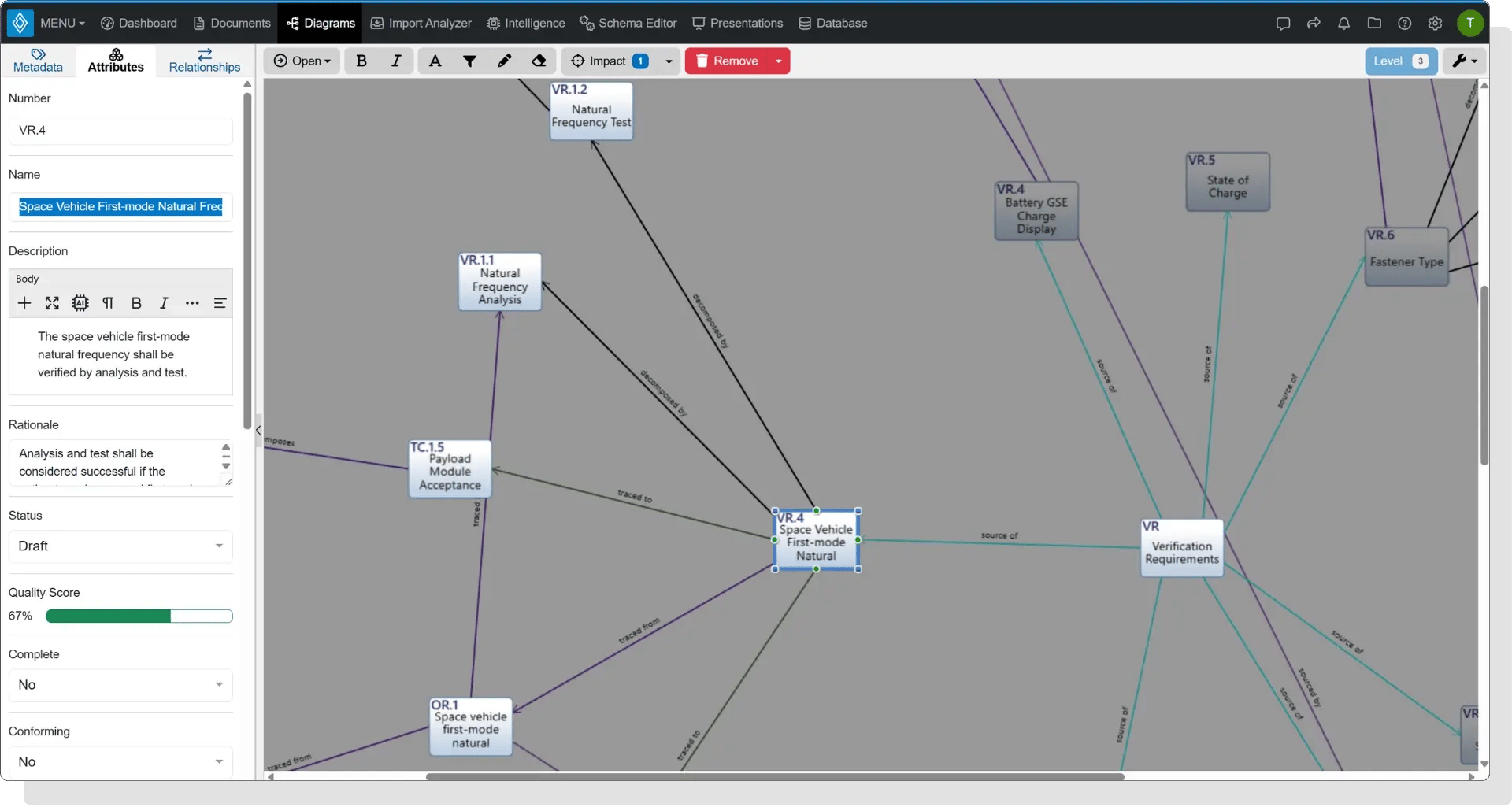
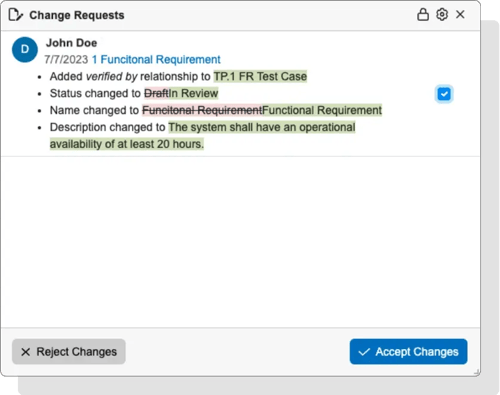
It also becomes especially valuable when teams need to manage changes to requirements. A proposed change can be evaluated against its connected system elements before the team decides whether to accept it.
📖 Related Reading: How to Use a Requirements Traceability Matrix (RTM)
Make requirements reviews collaborative
Prioritization should not happen in isolation. Include representatives from the stakeholder groups and disciplines affected by the decision. Depending on the project, that may include systems engineers, project managers, product managers, business analysts, developers, verification teams, customers, operators, or regulatory specialists.
During the requirements review, make the rationale visible.
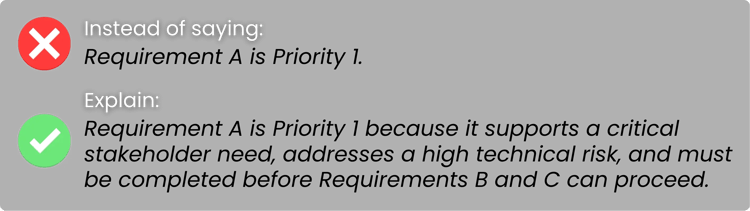
The second explanation gives stakeholders something concrete to evaluate.
Collaboration does not mean every stakeholder gets their preferred ranking. It means everyone understands the criteria, evidence, and tradeoffs behind the decision.
Maintaining that transparency is also useful when teams need to manage unrealistic stakeholder expectations or involve stakeholders in requirements validation.
Treat priorities as living information
Prioritization is not a one-time exercise; requirements change, risks emerge, budgets shift, designs mature, and stakeholders learn more about what they need. Effective requirements management treats priority as living information rather than a value assigned once and forgotten.
A requirement that was critical during concept development may become less important after a design change. Another requirement may suddenly become urgent because a dependency or compliance issue is discovered.
Establish a process for reevaluating priorities when:
-
requirements change,
-
new stakeholder needs emerge,
-
major risks are identified,
-
cost or schedule constraints change,
-
dependencies change,
-
verification uncovers an issue, or
-
the project moves into a new lifecycle phase.
Any change should also preserve its rationale. Teams should be able to understand not only the current priority, but why that priority changed.
How Innoslate supports requirements prioritization
Spreadsheets and documents can capture priority values, but prioritization becomes more difficult as requirements and their relationships grow.
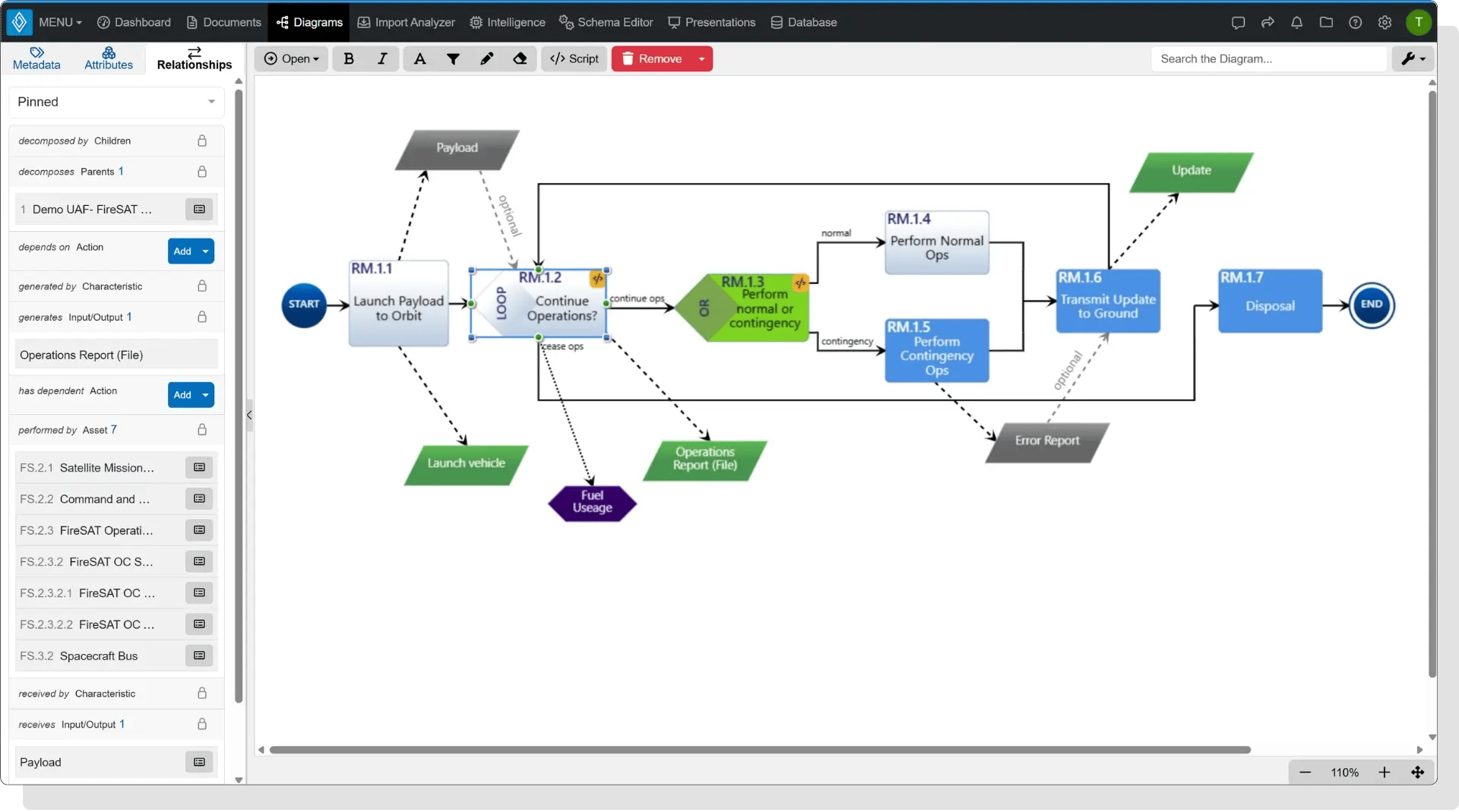
Innoslate supports requirements management by allowing teams to treat requirements as connected engineering data. Requirements can be linked with stakeholder needs, architecture, risks, verification activities, and other project information, giving teams greater context when evaluating tradeoffs.
Teams can use Innoslate to support collaborative requirements work, maintain traceability, review changes, and understand relationships across the system lifecycle.
That connected approach helps turn prioritization from a static ranking exercise into an ongoing part of requirements management.
Better prioritization creates better alignment
Requirements prioritization is ultimately a decision-making process. The goal is not simply to identify which requirement comes first. It is to make defensible tradeoffs while keeping stakeholders aligned around the mission, constraints, and desired outcomes.
Start with stakeholder needs. Establish objective criteria. Select a prioritization technique appropriate for the project. Maintain traceability. Review decisions collaboratively. And revisit priorities as the system evolves.
When teams can see both what was prioritized and why, difficult requirements decisions become easier to understand, communicate, and manage.
Use Innoslate to prioritize, review, and trace requirements in one connected environment. Try the Free Forever Sandbox.



.svg) SPEC Innovations Team : 9/30/26, 4:11 PM
SPEC Innovations Team : 9/30/26, 4:11 PM

.svg)
.jpg?width=30&name=1654525569992%20(1).jpg)